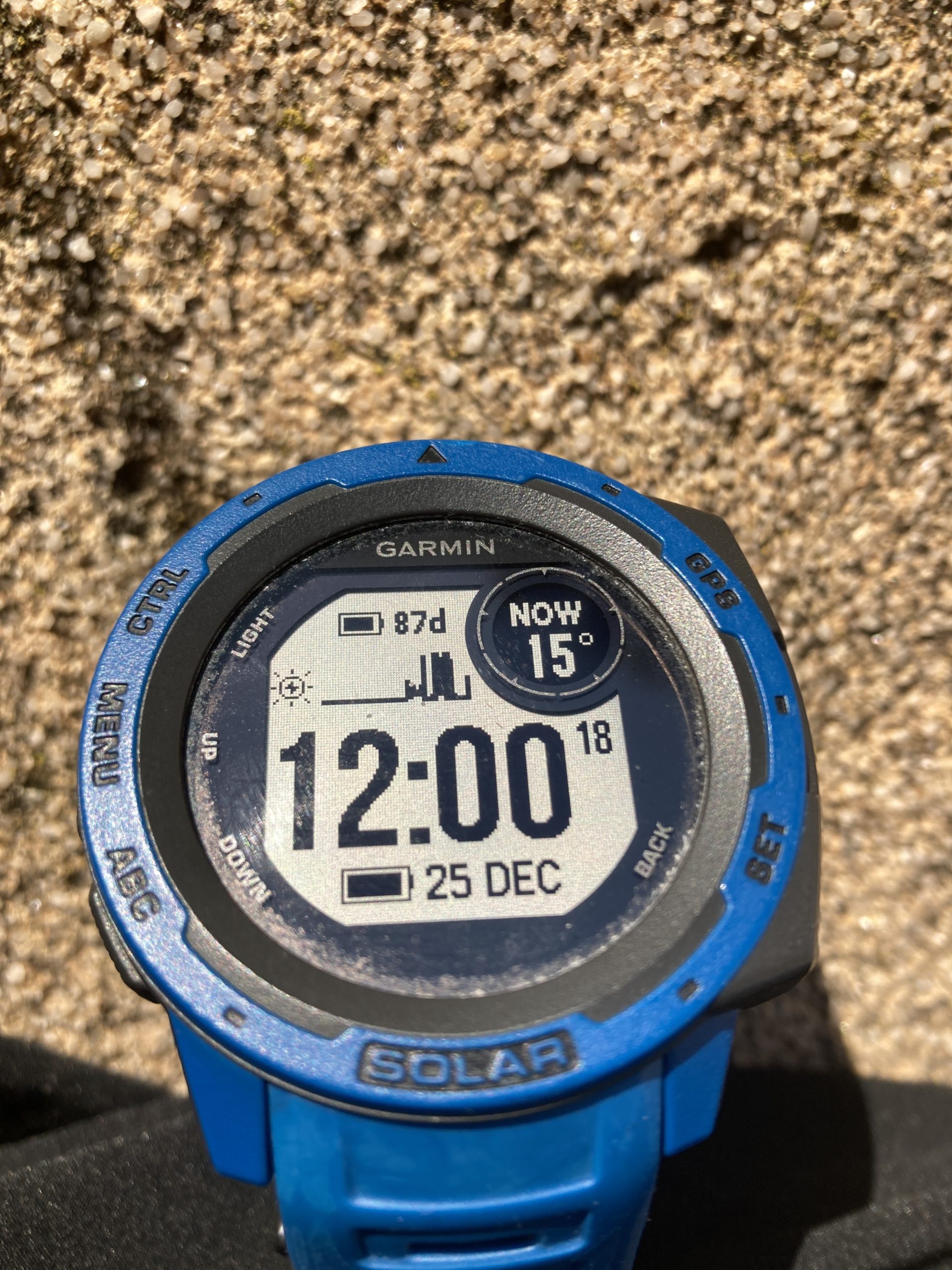
The Garmin Instinct Solar is an excellent watch if you like to hike and walk, but falls short if you want more detailed stats when you’re running. It doesn’t have HRV monitoring, fatigue and other features.
Years ago, when I was in Spain I was playing with the watch. I would leave it in the Spanish sun for hours at a time, making sure that the solar panel was facing the sun. I also used a solar panel to charge the watch with solar energy via the charging cable.
The result of that experimenting is that, in Spain, at the right time of year, the watch reaches 99 days of battery life. That 99 is limited only by the fact that the watch can’t display a longer battery life. It does eventually display an infinity symbol.
If we’re optimists then we’re likely to think “It’s great to have a watch with such such fantastic battery life but the reality is that the solar panel on a watch is too small to charge the watch whilst it is in use.
The other issue with a watch with a solar panel, especially like the Garmin Instinct, as opposed to Casio and other simpler watches is that we tend to walk with the watch face hidden from the sun. If we’re sitting at a computer, working, then our wrist is probably not facing the sun, so the watch isn’t charging.
If you’re in Kiruna, then the watch has even less exposure to daylight. During the Arctic winter it might never see sunlight, for weeks at a time. In such situations the panel is less useful.
Yesterday I left it on the floor by a window and it charged from “low” to 2 days of battery. Today it was back to low due to cloud cover. That’s without tracking heart rate, walking and more. The watch is doing very little, and despite this, still struggles to charge. To be fair it might have about five or six hours of sunshine, and most of that is the morning sun.
There have been two more versions since the Instinct. The Instinct 2 Solar and the Instinct 3 Solar. The Instinct 3 Solar has much better life, and more efficient solar charging, so, in the right conditions it can be energy neutral when working out. If you’re out on a summer hike, or bike ride an energy neutral watch allows you to go for the entire day, without worrying about battery.
Having said this with the Explore 2, Garmin Instinct 2, Forerunner 570, and more you don’t need to worry about this either. The instinct was excellent for hiking for years. it’s when the battery began to show signs of age that I traded up to the Instinct 2, but not solar, and it is because of my shift to running that I tired the 45s, that I found disappointing, and the 570 that is fine for tracking, but annoying with sleep in summer heatwaves, and negative when it comes to huge cycling efforts, followed by conversational group runs.
Leaving the Instinct on the floor, exposed to the sun charged the battery by one or two percent over two days. Plugging it in charged the watch to 50 percent within minutes.
With the Instinct solar charging is more of a gimmick than useful if you use the watch more than two hours per day. With the Instinct 3, from what I have read, solar charging provides real value, in optimal conditions.

Leave a Reply