This is an experience review, rather than a product review. During yesterday’s group ride I noticed that my rear tyre was feeling flat. I stopped to re-inflate it because the problem seemed minor but I made the mistake of not closing the valve properly before setting off again so the inner tube problem, that might have started as a slow leak became a more serious problem due to the damaged valve.
The first issue is that I thought a quick, simple solution, inflating the tyre would be enough. It might have been enough, if I had closed the valve after inflating the tyre.
In future I will automatically swap the inner tube, and then check whether the issue is a serious one or a superficial one. People were blocked at the Bogis Bossey traffic light anyway, so I had time to fix the tyre properly.
I didn’t want to keep the group waiting. Two weeks ago I had another tyre puncture and the group got cold waiting for me to fix the tyre. I did not want a repeat of that yesterday. That’s why I went for the quick fix.
Within a few kilometres my tyre was flat again when I was near the Crassier Pizzeria, near the Boeuf Rouge. I inflated again but this time the groups continued. The fast group, and the slower group. I re-inflated and my reflex was to head home but I decided to continue, to see if the group was waiting for me somewhere more convenient for them.
In the process I rode up to La Rippe and had to re-fill the tyre for a third time, right before the gravel bit. I then continued to the Golf de Bonmont and had to fill again, and then I had to fill one last time on the descent towards the Landi building.
That’s where the Cyclplus AS2 Pro proved it’s value as part of my kit. It costs 78 CHF now but I got it for half price during a promotion.
If I had used gas cannisters they would have been fast but I’d have to buy at least two or three new cannisters. With the Cyclplus AS2 and AS2 Pro, all I need is to recharge the battery before the next ride. The key difference is that with the AS2 Pro, it’s a tiny bit larger, with a display, and you can preset the pressure. With the AS2 you rely on tactile feel to decide when the tyre is ready to continue the ride.
Lesson Learned
If the inner tube had been completely flat the decision to replace it would have been automatic. It’s because it seemed to be a slow puncture that I chose to “inflate and ride home”, rather tha replace it. Next time I will know that the simplest solution is to change the inner tube there, and then.
The Inflated Inner tube remount
This morning, after yesterday’s misfortune I decided to test something I had heard recently. “Inflate your inner tube before adding it to the wheel.” I tried that and it worked fantastically. The logic is simple. When the tyre is completely flat it gets twisted and moves around. When it’s inflated it doesn’t move around or twist so it really speeds up adding an inner tube. Within seconds you can replace a tyre, and within minutes you can be back on your way.
Now that I have taken the time to test this, from the comfort of home, I can apply it to future tyre misfortunes, whether mine or someone else’s.
And Finally
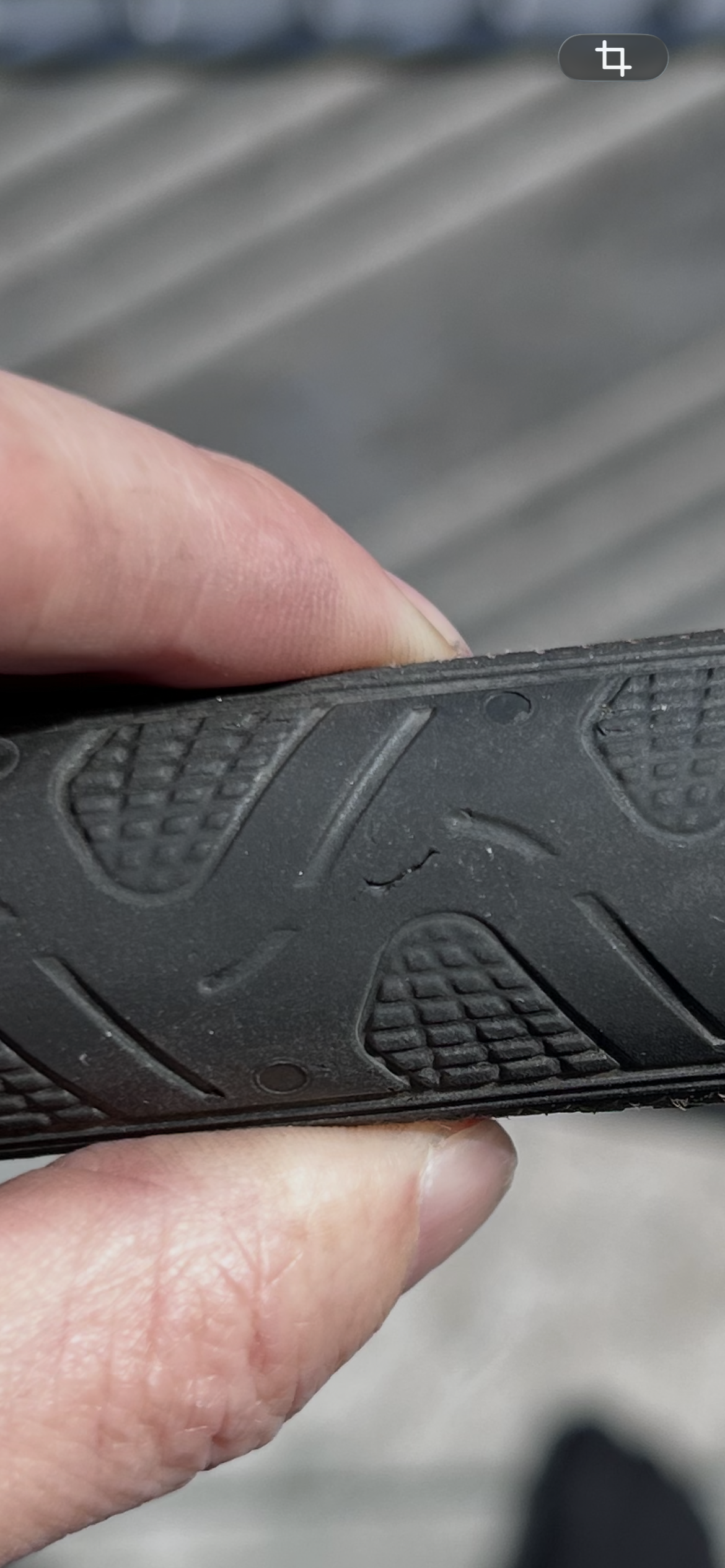
I inspected the GP 4 Season tyres, and my wheels visually, and then with paper towels, before a final tactile check. None of them showed traces of FOD. I can only come to the conclusion that with my tyre pressure and riding style, the GP 4 Seasons are not suitable. This morning I reverted to the GP5000 tyre for the rear, and I will swap the front one shortly.
I was trying GP 4 seasons out of curiousity and because of winter, but now that spring is back, and that I have had punctures I am happy to revert to tyres that I know and trust. I have, so far, found GP 5000 tyres to be reliable.
Silver Lining
If my inner tubes continue to fail every two or three rides I will become proficient at changing tyres. I suspect that I will struggle less on faster rides, now that I’m back on GP5000 tyres.
Leave a Reply