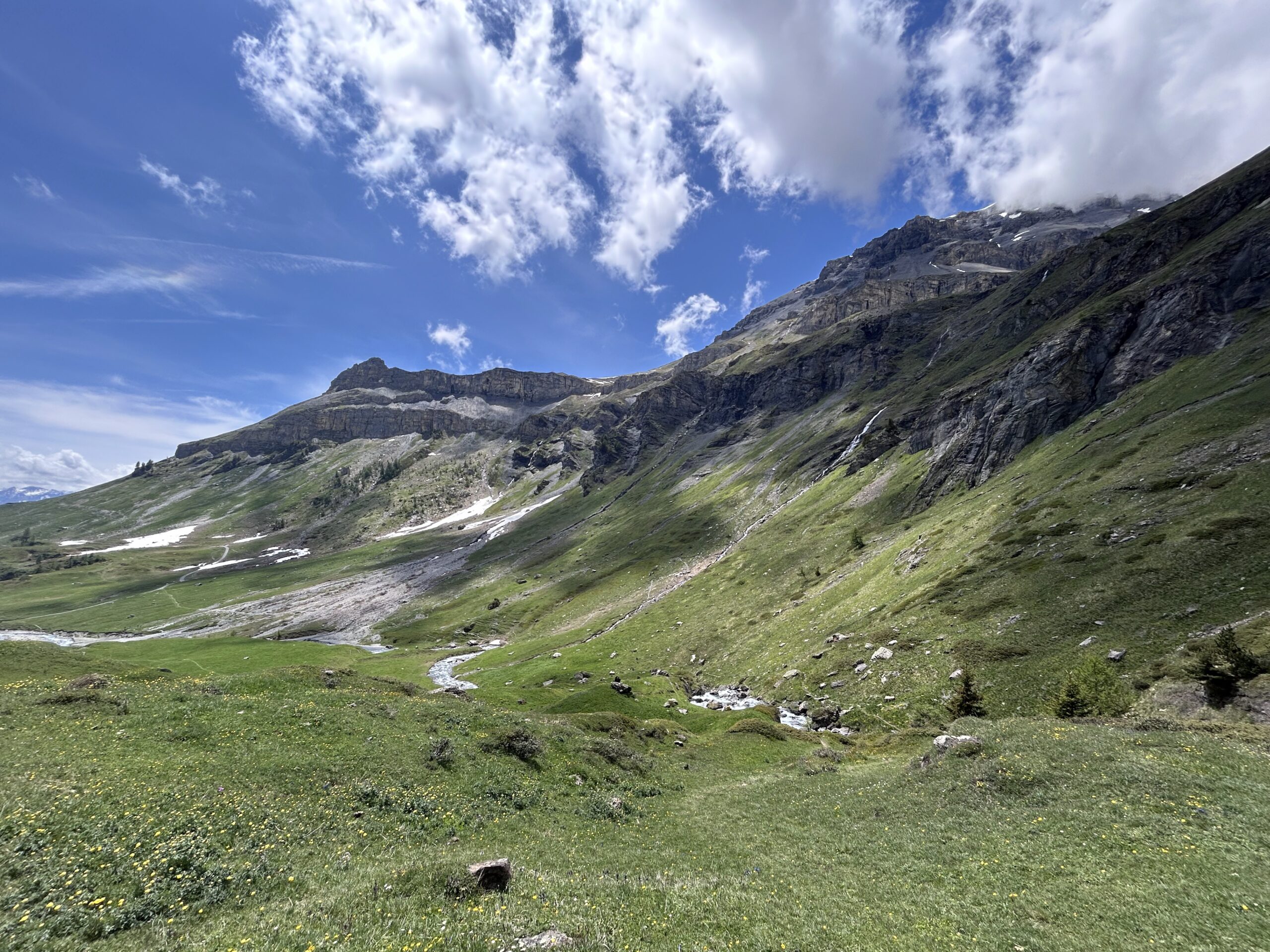
The hike from Aminona to Leukerbad is a 22km+ hike with 1200m+ of climbing. You begin by catching the cable car from Sierre to Crans-Montana, and then the bus to Aminona, before walking along the road for a bit, before turning right and disappearing into the woods and walking along trails that head downwards for a bit before heading up a “steep” gradient.
During the steep gradient I found myself thinking about the mechanical difference between cycling up a hill or mountain and hiking. When you’re used to cycling up hills, your cardiovascular system adapts, but so do your leg muscles. They have to lift you, the bike, and cope with gradients. In contrast, on foot, the effort is constant. We way the same at the start of a climb as the end, without changing gears. We’re biologically optimised for the climb.
The second thing that struck me is that walking at a group’s pace, up a mountain felt easy to me. This isn’t meant as arrogance. When I was doing 2000m of climbing last monday, and 1200m of climbing last Sunday I felt the effort. I felt that my legs wanted to quit. I felt that I was pushing to my limit with cycling groups.
It’s an interesting that the physical effort of hiking gave me a good base for cycling, and that now cycling has given me a good base for hiking.
Specifically, if I was hiking alone I would have been walking up at my aerobic maximum, rather than walking half as fast as I feel I could, like I did when hiking from Leukerbad to the Lammenhütte.
If I had done the hike solo, it would have been entirely over within six to six and a half hours. With a group it was over in nine hours.
That’s a distraction. The hike is nice because it goes by a waterfall where you walk underneath it, and then you walk up through a forest until you get to a clearing, with a picnic area, if you want to stop for lunch, before going along the river Tièche.
It’s when we got to the top of that climb that the group stopped for lunch. Two of us walked to the waterfall that we could see in the distance. It was large, and filled with water from snowmelt and recent rain/snowfall.
It is around 16km in that you begin to see Leukerbad and the Daubenhorn. That is the special moment for me, because I have done the via ferrata three times, and the Lammenhütte hike once. I really didn’t want to do the VF a fourth time.
During the hike I noticed that the pines looked much older than at lower altitudes. I sense that humans have not cut down trees so high for firewood or other uses. Later, especially from Larschy towards Leukerbad you see fields saturated with flowers, and the sound of crickets. You also have an exposed descent with a cable, but no safety wires. That exposed bit is not for everyone.
What struck me during this hike, is that despite the 1400m of climbing my heart rate remained at an average of 100bpm. That’s the same as a quick walk in Nyon, despite the huge elevation gain and altitude. The suffering I do, when keeping up with cycling groups paid off when hiking.
Whilst the hike was relaxed from a cardiovascular point of view, it was not relaxed from a physical point of view. The hike itself was 39500 steps for me and I was standing almost the entire duration of the hike. I didn’t stop for a “lunch” break. That’s when two of us went to see the Tièche waterfall.
It’s later in the walk that I saw the limitations of my shoes, and lack of hiking. I kept hitting my right toe against rocks. Since the shoes have no protection it hurt every time. If I resume serious hiking I need to get shoes with proper toe protection because more than once I felt real pain.
My fuelling strategy was split in three. I had 700ml of water and 600ml of water with electrolytes. The 700ml container was a water filter. My strategy was to drink tap water for the first part of the hike, and then to filter water the rest. It paid off. I drank at least 1.8l of water, once filtered.
I also had a chausson aux noisettes at the start, a second part way through the hike, and the third at the end of the hike. I also had gummy bears every so often. I used a similar strategy to cycling and it worked well.
I believe the toll came from the duration of the hike. If I was hiking solo it would have taken six hours, but because I was hiking with a group, I climbed fast compared to the group, but at a comfortable pace for me. On the second half, for the descent, I stayed near the rear of the group. I naturally slow to make sure that everyone is with the group at the end. I could have been home an hour or two earlier if I had rushed. That wasn’t the aim. This is a group activity so I stayed with the group.
With cycling my frustration is that after climbs, people speed up. They did the same within the hiking group, but that is when I slow. That is when I remain with those that are less experienced.
I noticed that one person was out of site so I stopped. I looked upwards until I saw the person emerge with two or three others, and then I continued descending.
That’s when fatigue demonstrated it was there. I kept kicking my right toe against rocks and feeling pain, and in the last two or three kilometres I could feel that I had hit a wall. Intensity wasn’t the problem. Duration was.
It’s worth highlighting that before I switched to cycling we were doing such hikes two times per week. We would do a 23km hike with 1200m of climbing on Saturday, and again on Sunday. It became routine. That’s why doing this once, especially in a rested state, felt okay. I believe that if this had been a solo hike I would have pushed harder, but felt less fatigued. I believe that I’m feeling the walk today, because it was a nine hour effort, rather than six, at my natural pace.
I would definitely walk with this group again, and I would walk the route again.
Leave a Reply