Rock Climbing

Iredpoint by Frogg GMBH

Frederik Riedel - 4th Jan, 2019

Hey Richard! Thanks a lot for using my app, and thanks for the great feedback, I definitely appreciate that. The upcoming update of iRedpoint has a big improvement for the top rope tracking algorithm, I hope you’ll like it. Also the ability to switch the climbing activity type during a session makes a lot of sense to me; I put it on my todo list! — frederik
Iredpoint by Frogg GMBH

The Apple watch and other devices have integrated barometers that allow them to track changes in altitude. Iredpoint by Frogg GMBH is one app that takes advantage of this. It allows you to tell the app what type of climbing you are doing as well as the difficulty.

Types of Climbing

This app allows you to choose the type of climbing that you are doing. You can choose between bouldering, top rope climbing, sport climbing, trad climbing, multirope climbing, free solo, aid climbing and last, and most awesome of all, Via Ferrata. I’m pleasantly surprised by that last one. In summer this is one of my favourite pass times.

Documenting climbing feats

Documenting climbing feats is an interesting challenge because you deal with issues of accessibility, projects that can last for months or even years and in some cases you’re dealing with the prospect of the climber understanding the problem, and then achieving his goal. For two or three years I really explored ideas for a climbing documentary before losing steam. My interest in the topic was still there but I couldn’t think of whom to put in front of the camera. 

The Right side of the transmission chain - acquisition

The right side of the Transmission Chain is at the event itself.  Transmission chain is a term used to describe the route that a signal takes from an event venue to the device on which you are watching an event. As a camera operator the right side of the transmission chain for me is at the event itself.

Belaying

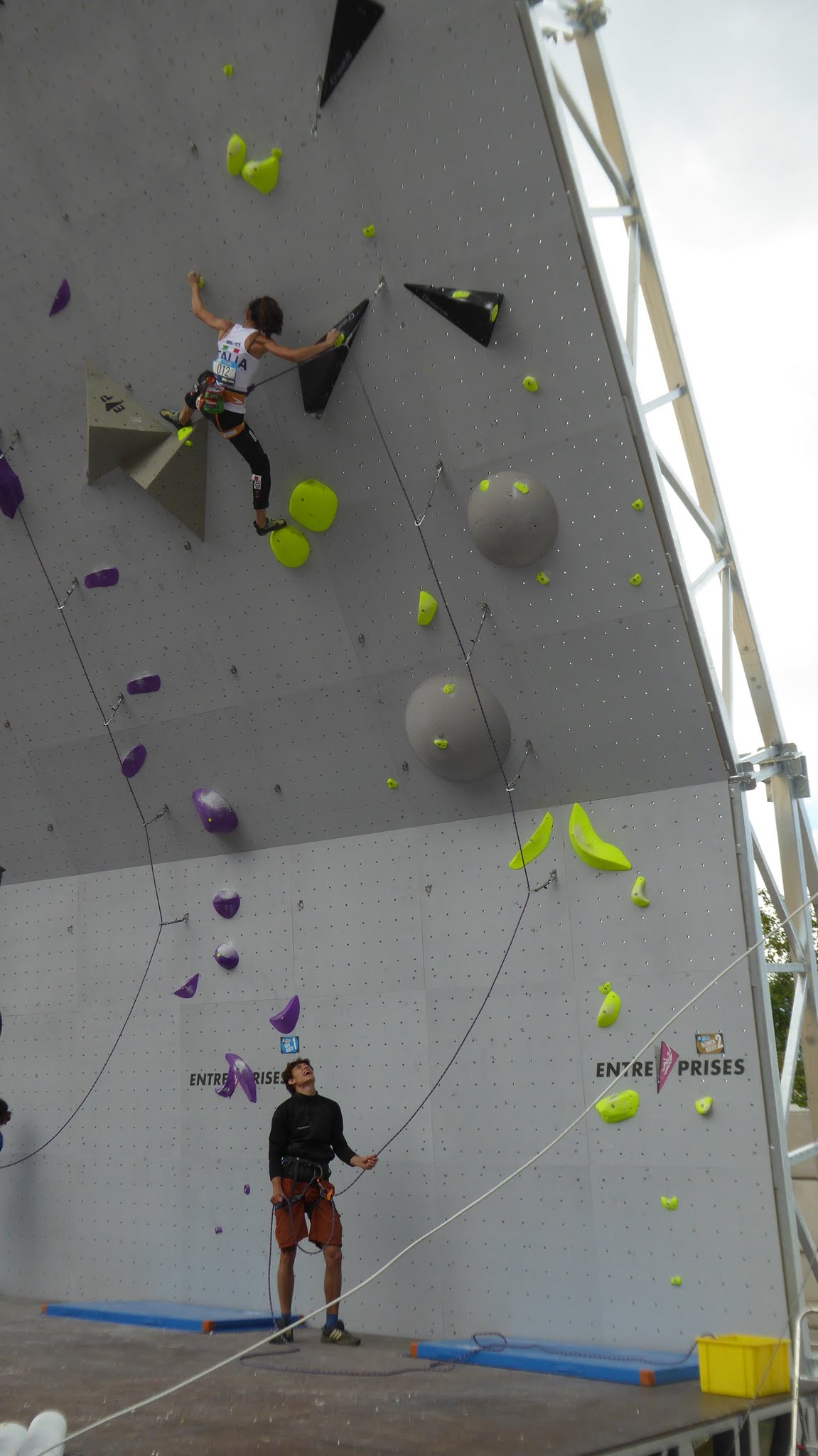
For the IFSC World Cup in Villars this year I was both a camera operator and a belayer. Belaying at a world cup event is an interesting experience because it’s rare to clip and unclip from so many climbers in such a short amount of time. Climbers have a limited time to get up the route. They have six minutes. This means that every 12 minutes or so you’re belaying a new climber as they progress up the wall. It’s a great task for introverts. You observe what the person is doing. When they need rope you’re ready to give it. If they’re struggling you make sure to amortise their fall. When they make it to the top or come back down you help them untie the rope and then you start again.

Improved Belaying - perfecting our technique

Belaying is a core climbing skill. With good belaying a climber can climb as fast as he is comfortable to climb, as if without a rope and yet have his fall cushioned at be safe at all times. The belayer needs to be active. He needs to observe and be attentive. I first learned to rock climb with a rope about ten years ago on the Italian side of the Alps and at the time I enjoyed climbing more than I enjoyed belaying. I then spent several years climbing via ferrata instead. The advantage with via ferrata is that it’s a simplified form of climbing. Over a year ago I started climbing indoors daily as I finally found a group with which to climb. My interests and skill in belaying improved. Yesterday I assisted a short belaying perfection course in anticipation of the Villars IFSC climbing event. During this session we were reminded of a few key points.

Clean Water for Hikes and cycling, without the weight

Clean water is important to have when you’re cycling, hiking or climbing in summer but the issue is that it is heavy. When I go cycling I go with just one flask and I fill up the water bottle when I get to fountains that are marked as safe to drink from. When I go hiking or climbing I usually do not go with more than one and a half litres of water although I have gone with up to three litres for a hot summer day’s activities when the temperature is above 32°c. In Switzerland, France and Italy you theoretically do not need to walk with that much water because you cross streams, fountains, rivers and lakes. If you had a water filtration system you could theoretically purify the water from these sources and continue hiking. Yesterday I came across Katadyn and two solutions for water filtration.

The Drapel Climbing wall near Aigle

The Drapel Climbing Wall near Aigle is a nice place to climb. When I was there yesterday we were in the shade of the trees unless we were climbing. The temperature for this week is at around 25-27°c daily which is nice. These are almost summer temperatures, at last. The parking for this climbing wall is

Getting there

The parking for this climbing wall is here. I’m giving a specific location because when I looked at maps I was not filled with confidence. To get to the parking you go to Yvorne and from there towards Vers Monthey. You drive through a narrow gap between two houses and then along a viticultural road towards the forest. You go up a dirt road for a few metres. The parking is a clearing in the woods. From there you walk for between 10-15 minutes. You know you’re at the climbing wall because there is a bench overlooking the castle. Come back a few metres and you’ll see the climbing wall where there are routes.

Interval training and climbing are a good combination.

If you were to look at the graph below you would clearly see that it’s a form of interval training but you’re at a loss to know which sport it is from. With running and cycling you would see 2-3 minutes of hard effort and then two to three minutes of less effort and it would repeat form 15-20 minutes. This graph is from an activity done for two hours. [caption id=“attachment_3480” align=“aligncenter” width=“1024”] What is the first sport that comes to mind?[/caption] This graph is from indoor climbing yesterday. You see that I started tracking the heart rate at least ten minutes before my first climb. You see that the heart rate during the first climb climbs consistently until I reach the top. As I get lowered back to the ground my body goes back to being relaxed and you see the low heart rate as I belay someone. The second climb is more challenging so you see the peak earlier in the climb and then it remains stable. The third climb was a little harder and you see that I had to rest at least twice. The fourth climb was managed without resting. With the fifth climb we see that I really needed to rest at the point where the troth is. From what I remember of the last climb it was easy except for parts where you really need finger strength. As I do not I cheated. I don’t climb frequently enough. I noticed that Rocspot Echandens has logged their climbs so that they are compatible with myclimbs, an app that I installed on my phone many months ago but forgot about. At the time it was still in early development so was not of much interest. Next time I go I will use the app.

The Tiny House movement and travel

The Tiny House Movement and travel combine well together. In this video a Czech couple bought a fan and transformed it into a self contained home to live in for a year. They chose it because they wanted room for the surfboards, wet suits and more. It has space for cooking lamb shanks, socialising and sleeping. You can enter the van both from the front and the back. I really like the idea of this van. It would be fun to travel for a few months from place to place, do what there is to do, see what there is to see and then move on. This would adapt well to hiking, climbing, via ferrata and other sports. It allows you to live comfortably without spending money on hotels, villas or other places. The project cost them around 10,000 dollars to build so if you work and save up for a few months you could easily take a gap year and afford to do such a project. Working on such a project does require some skills in wood working. He said that it took hundreds, if not thousands of hours to prepare the van. If you’re travelling then a few steps a day for a few weeks would get to this final result. At one moment they speak about the herb garden that they have in the glove box. As they had the space they planted some mint and other herbs for cooking. As a result of this herb garden they said that when driving on rough roads the Mint plant gets shaken about and in the process the van smells of mint. It’s a natural air freshener. In a month they will move on and sell the van to continue travelling. If I was travelling to New Zealand I’d like to try living in a van like this and use it as a base to go hiking, climbing and enjoying other sports. This seems like a pleasant way of travelling.

Strava Now Has Rock Climbing, Hiking And More

David - First of May 2018

Hey Richard. I actually built an app to solve this problem. I’m a climber and a runner and I wanted to be able to track my climbing and see all my exercise in one place. You can log your indoor climbs in the app and it lets you enter the grade, how many tops you completed and tailors everything to the specific gym you’re in. There’s no outdoor climbing yet but it’s planned for the future. Check it out on https://www.clamberapp.com if you think it will help you.