Social Media Living Room

Did anything happn?

Happn is a location based dating app, at least in theory. I have had the app on my mobile phones for a year or more and have yet to meet a Happn user in person. In theory Happn shows you who you have crossed paths with and where. It also tells you how many times you have crossed paths with specific individuals. One of the biggest limitations of this app is that for now users of the app are based in cities rather than the countryside. As a result I will cross path with dozens of people I go to Geneva or Lausanne but will cross paths with no one when I am up enjoying a via ferrata. I find this to be a shame. It is precisely when I am on a via ferrata that I want to find people to share the passion with. A few days ago I was at the Plainpalais fanzone in Geneva as people queued up and waited to get in to watch France Versus Germany. I launched the app and saw that a lot of people at the event had the app active. I walked away from the fanzone and forgot about the app. So far with this app I do not remember having any matches or making any real effort to meet people that I see come up. Some apps are fun for statistical analysis rather than face to face encounters. Two people I know have turned up on the app. I have enjoyed a few via ferratas with one of these people and worked on a number of interviews with the other. One is in Lausanne and the other in Geneva. We will see if I ever meet someone via the app. Knowing me it will happn (;-)) when I can be bothered.

IFTTT - Instagram to Twitter

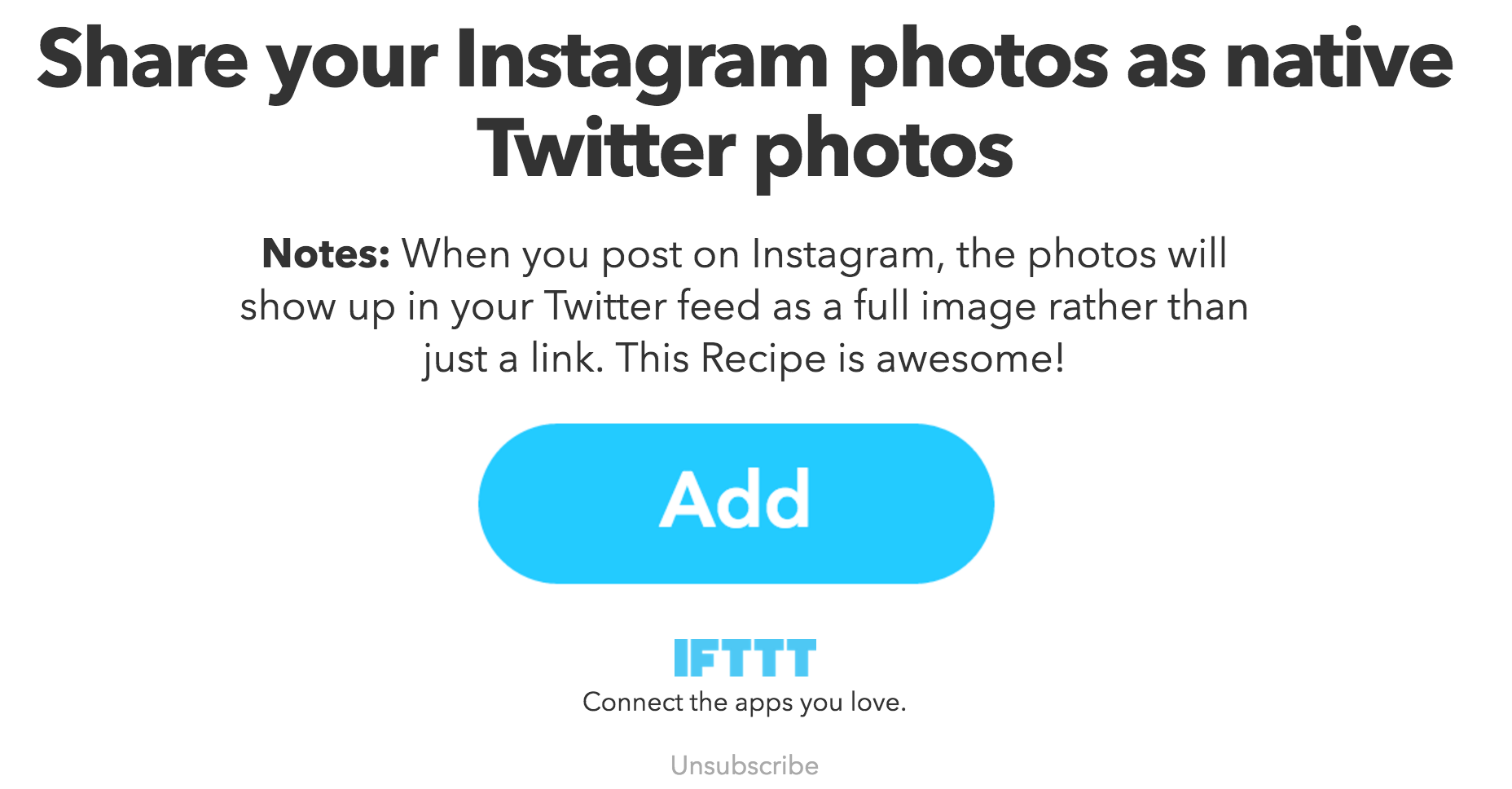
Instagram is still a healthy social network. It still finds an engaged group of users who want to share their adventures, meals, friendships and more with other users. Some of them love sharing selfies and others share beautiful landscapes. This keeps the network vibrant and young. Twitter on the other hand has neutralised peoples’ passion and engagement with the site. They wanted to become google reader, they wanted mass following of key accounts, they wanted to neutralise the social, conversational aspect and they have succeeded in their goal so effectively that now an IFTTT rule reduces the need to visit twitter. [caption id=“attachment_2980” align=“aligncenter” width=“660”]IFTTT Instagram twitter Which network do you prioritise[/caption] When you share your instagram photos as native twitter photos you are hiding that you are disengaged from Twitter. By hiding this disengagement from the social network you are hiding that you may not respond to replies, mentions etc. By not responding to those interactions you are negating the purpose of your presence on the social network. [caption id=“attachment_2979” align=“aligncenter” width=“660”]Twitter declines further The once social network Twitter continues to decline[/caption] When you fail to interact directly with websites such as Twitter you perpetuate the notion that twitter is a place where bots interact with bots because humans are no longer present. When humans are gone, when interactions between users no longer take place then what remains of the “social network”? Two hundred and ninety six thousand people have added this recipe to their IFTTT accounts. A quarter of a million people have chosen to spend time on Instagram rather than twitter. For this reason it makes sense to share pictures via Instagram. We will see your instagram account and we can start following it. In so doing we spend our time more effectively. Instagram still has a future. If you post to the networks that you want to use there is a good opportunity that others will want the same. Lets cut out twitter. ;-)

The Post Social Media Era

I believe that we are shifting towards a Post Social Media Era where social networks are built in to online activities. People love to say that online social networks and social media are a waste of time and that they have a negative impact on how we feel about ourselves. For years I have been trying to demonstrate that social networks and social media are as valuable and important as socialising in person. The first 17 minutes are about a game that attempts to provide the player with empathy for those suffering from Anxiety. It then inspires Jack Septiceye to provide us with a look at how he felt after leaving college, how youtube helped him connect with people and how it had a positive impact on his life. When most people read about social networks and social media they read about making money, social media marketing, trolling, disinformation, depression and many other topics but very few of these articles look at the positive impact that connecting with people can have through social media. Social media, after all connect people whether they live in the middle of a big city or in the middle of the countryside. When you live in the countryside and practice sports in the mountains then the car and social media are equally important for having a sociable life.

Quora and lateral thinking

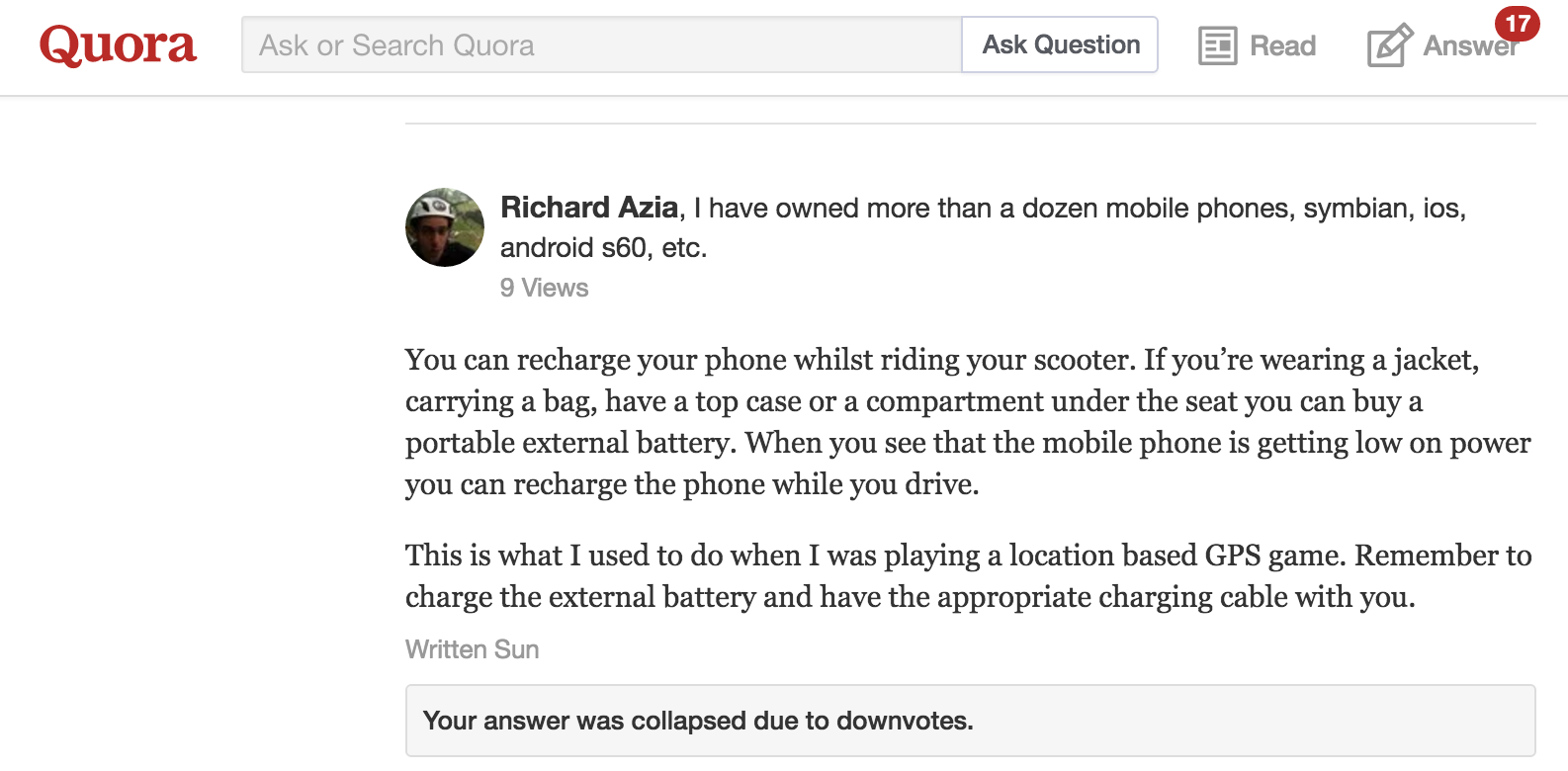
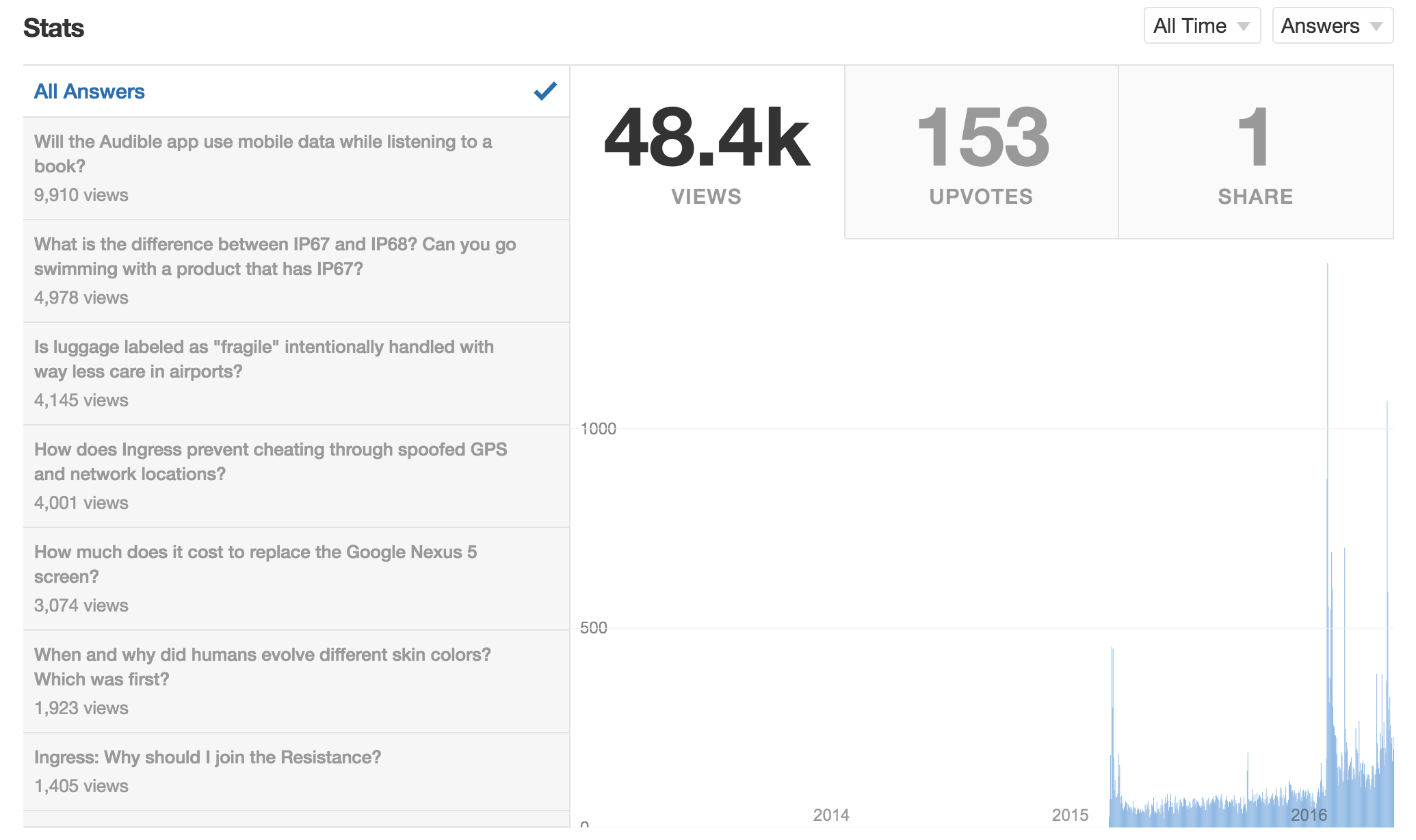
Recently I saw the question “Why can’t I charge my mobile phone while riding my scooter?” on Quora so I decided to provide the answer that you see below. In my eyes my answer is legitimate. As an ingress player, as a scooter driver, and as someone who has done what I describe in the answer below I do not see why it is not a valid answer. Quora and lateral thinking are not synonymous. It would seem that Quora users do not like lateral thinking. [caption id=“attachment_2919” align=“aligncenter” width=“660”]Downvoting legitimate answers Downvoting legitimate answers[/caption] This is a legitimate answer because within the ingress playing community everyone that I have met uses an external battery to recharge their phone whilst out and about. Some of them carry the battery in a pocket, others in a bag and yet more of them have a special case for the bike so that they can play the game with ease whilst moving from portal to portal. If you haven’t played Ingress on a bike then you should definitely try it. To have a reasonable answer downvoted by a user of Quora degrades my motivation to contribute to the site. I was once threatened with a ban for providing a link to back up and source what I had written. A second time I had personal attacks for writing a question to a questions asking for thoughts on a topic and now I see this downvote to a legitimate answer. Social networks and online communities should be about open and free discussions where peoples’ thoughts and opinions are valued. When they are not valued then the return on investment for community members declines. It also discourages people from contributing to the community. Ideally you should highlight what you like and ignore what you dislike. By ignoring what you dislike you offend no one. You discourage no one. Quora stats In the grand scheme of things I have had 153 upvotes and only one downvote that I am aware of. This should not discourage me from using the network in future. I will take a break from the social network once again. Other social networks are more inviting, more open, more stimulating.

Social Media and The Human Return on Investment

Social Media and the Human Return on Investment, because contrary to popular belief we use social networks to socialise, not to shop. As we grow older and more mature our close network of friends changes and evolves. We go from school friends to university friends and then to professional friends. In the process we move from a village to another village, from a town to another town and eventually from one city to another. In the process the links we have with some friends strengthen and others degrade over time. This is modern life. I find it hard to discern whether the return on time invested on social networks like Twitter, Facebook, Google+ and others is decreasing because people’s understanding of these social networks is shifting or whether it is related to growing up. As the people I know get married and have children their priorities change and privacy becomes more important. We have to keep the children safe. Facebook, as a social network is less engaging than it used to be. The people I have as friends post less frequently, the events we can participate in together is shifting and the content shown in timelines is evolving. To compensate for the decline in friends engaging in social networks like twitter and Facebook people are following publications, brands and news sources. This flow of information is tailored to the lowest common denominator. The sensationalist writing style discourages me from following these sources of information. I have a concern that what were social networks until two or three years ago have become advertising networks on which people occasionally socialise and interact with other individuals. I feel that a bigger and bigger portion of the time that people spend on advertising networks is looking at mainstream content and comments. On Facebook as I scroll down the timeline I notice an increasing number of adverts. Personal posts are less and less frequent. Has the community left this “social” network? I have spent years thinking about online communities and how they interact. During this time I have seen the ebb and flow from one type of community to another across multiple platforms and applications. Within the next two to five years social networks will be virtual reality environments such as we saw with World of Warcraft, Everquest and Second Life. The question is whether people will want to socialise in virtual reality or whether it will be populated by gamers. Every online social network is stigmatised. This stigmatisation prevents people from fully exploiting the potential of social networks. We see this stigma through the use of dating apps rather than Twitter, Facebook, Google+ and other social networks. Dating apps are stigmatised but at least you swipe left or right and you’re done. ;-). You’re only “active” for a few seconds at a time. On Facebook and twitter you need to be active for hours, days, weeks or even months… You have to be careful. You may be stigmatised. ;-) Now that most people see social networks as a waste of time it gives us more time to do other things. It gives us time to read, to do research, to watch television and even to go two or three hours without looking at a mobile or computer screen. Imagine that. ;-) I believe that on the one hand the stigmatisation of Social networks as a waste of time has discouraged people from using them to their full potential. As a result of this people feel comfortable spending ten to fifteen minutes a day on these networks. On the other hand I see marketers, public relations specialists and advertisers push for their campaign to be seen. As peer to peer communication goes down and human return on investment (ROI) decreases, and as marketing campaigns take over the timelines they are effectively closing the door on people’s motivation to spend time reading through their timeline.

My love/hate relationship with twitter turns Ten

I have been active on the World Wide Web for two decades, two thirds of my life. Half of that time has been spent as a twitter  user. I was among the first to use the service and I saw it go from being a curiousity to being the most popular conversation tool around. When twitter was young the iPhone was in it’s infancy and data plans did not exist. As a result it was SMS based. The SMS idea was short lived as it ended up costing the twitter founders too much. Twitter owes an immense debt of gratitude to Apple, the iPhone and the shift towards mobile data plans somewhere other than Finland. When we were Twitter infants, when we were discovering the network and thinking of how to use it we were stuck at a computer and dependent on wifi and power sockets. If we left the house we missed on the conversation. Twitter at the time was a compelling network, especially since I was lucky enough to live in London during the golden age of Twitter. Twitter is a fantastic and compelling social network that has the wrong people affecting its feature. Marketers, public relations professionals, investors and other groups are too busy trying to push content to people rather than attract people. Yesterday afternoon I came across the term “Organic Social media” in relation to Instagram’s shift from a reverse chronological timeline to an algorithm driven timeline. A shift in the definition of social media has taken place. A decade ago social media implied that people were sharing content and commenting on it. They were making statements and friends and colleagues would comment conversationally. Marketers et al have destroyed the conversation and shifted everything towards an “I am the best so look at me” fed by likes, comments, shares and other tricks. As Twitter turns ten years old I grow curious about the future of friendships and online conversations. I question whether social media landscapes will become as unfriendly to introverts as bars in the physical world. Will social media become the place where the most conventionally appealing individuals thrive?

Stop wasting time on Instagram with friends - Algorithms and attention

Instagram is a photo based social network that allows two types of users, ego-maniacs on one side, and explorers on the other, to share images of interesting things they see and do. Some people share beautiful mountain images and others share images of their trips to Paris, Rome and more. I share images of Via Ferrata, climbing and a number of fun sports. The ego-maniacs share images of themselves in as many places as possible. Instagram is a “last active, first seen” kind of social network. We see the most recent images first. We see active users frequently. Less engaged viewers are less visible. This is a participation reward model. The more engaged you are with the community and the more people will see your content. There is no favouritism. The algorithmic timeline will penalise the most active users and encourage the cult of personality. The Cult of Personality social media model is great for marketers and public relations accounts because it makes those with the most likes and comments more visible. When you’re conversing with two hundred or more people this is enviable. As people interact connections are created and communities form. Conversations are a two direction affair. According to Statista Instagram now has 400 million users. Selena Gomez is the most followed person on Instagram at the time this post was written. 69 million people follow the account. Images from the account are suitable for a glossy magazine rather than a social network. They lack in warmth and familiarity. The account is cold as a result.  These cold and impersonal images can easily get a million likes and algorithms will push this content to the detriment of images by friends and family. [gallery ids=“2784,2785,2786”] Chronological timelines are great because activity and personal engagement reward account holders. When you switch to an algorithm based timeline you will unfollow celebrities to avoid having their posts flood your timeline. Facebook demonstrates what happens when you shift from a chronological timeline to an algorithm timeline. User engagement and interest declines and what were once vibrant conversations lose in appeal and the return on invested time, for users declines. This decline results in the network’s tab being closed in our browsers and the app becomes dormant. Dormant networks resort to sending e-mails to re-engage their users. Both Twitter and facebook do this. Imagine if you received a tweet to let you know that you got an e-mail or that e-mails appeared in your Facebook timeline. It demonstrates that networks like Facebook and twitter, by focusing on making money, forgot to make their products essential. By making this mistake both Facebook and Twitter need to nag us to come back via e-mail. If algorithms are used in timelines then the algorithm should keep posts by our friends chronological and apply the algorithm to celebrity accounts. We already have an algorithmic option on Instagram via the explore tab. Instagram must resist the urge to break personal timelines as this will disengage users. [gallery columns=“2” ids=“2787,2788”]

Narcissism and the World Wide Web

According to a New York Times writer, Narcissism and the World Wide Web are increasing. “Narcissism is increasing…

If our egos are obese with amour-propre, social media can indeed serve up the empty emotional carbs we crave. Instagram and the like doesn’t create a narcissist, but studies suggest it acts as an accelerant — a near ideal platform to facilitate what psychologists call “grandiose exhibitionism.” No doubt you have seen this in others, and maybe even a little of it in yourself as you posted a flattering selfie — and then checked back 20 times for “likes.”

Conversational Social Networks

Ben Thomspon wrote, “How Facebook Squashed Twitter”.  The article looks at social networks from a marketing point of view. I like conversational social networks. Social networks by their very name are for conversations. They are about connections and they are about friendship, collaboration and more. 

In its Golden age twitter was a social network to establish new friendships with people we had yet to meet. It was a great tool, especially in places like London where the community of users was big enough to be interesting. Facebook, on the other hand, was a network of school friends, university friends and eventually colleagues. Facebook was more of an interactive yearbook.

The idiocy of the Hashtag

Every day I am reminded of the Idiocy of the Hashtag. Twitter is a conversational medium where the more we converse the more addictive the social network becomes. Every single @ reply was a reaction to what we said or shared. Connections between users were strong and so the network effect took twitter from being a strange experiment in 2006 to being a social network from 2007-2009. In those days we engaged with people directly. Social media marketers, people with families and other priorities came to twitter and decided that they would indoctrinate people in to seeing twitter as a broadcast rather than conversation tool. Broadcasting did away with the conversation. It replaced the conversation with buzz words like ROI (return on investment) and other buzz terms. From a conversational medium where everyone talked directly to everyone else these “experts” hijacked the conversation and encouraged the use of the hashtag. The hashtag took person to person communication, encapsulated it in a hashtag and neutralised the individual to individual communication channels. Individual to individual communications are what makes all social networks addictive. If I believe that someone wants to listen to me, to talk, to exchange ideas then I am likely to make time for them, to read what they have to say, to create a personal connection. That personal connection had me travel to Paris, London, Geneva, Lausanne, Lille and other destinations. Imagine that twitter was still a conversational medium. Imagine that we established personal connections with the event organisers. Imagine that instead of a hashtag we were talking with the twitter account of event organisers. Imagine for a moment that twitter was seen as networking, that socialising on this network was not seen as a waste of time. Imagine that it was seen as a wise investment of time. I was at two international events last month in Geneva and I had my laptop and a data connection (or two if we count event wifi). I could have listened and live tweeted the events and I could have engaged people socially. I could have engaged with the panel and the speakers. They want me to use a hashtag. I refuse to use hashtags because a hashtag is not a conversation. A hashtag is metadata. Metadata should be used to help with threading but should not be the conversation. The conversation, comments and thoughts should go directly to the organisation. The impact of a conversation is far stronger than a hashtag. A hashtag is solitary, is lonely, is disjointed, fails to engage. We see it’s weakness every time an event takes place. I was at one event where I saw that the hashtag only appeared in tweets by the event organiser. The only other place it appeared was in retweets. If you work as a social media marketer you need to engage with people. You need to get people to reply to your tweets, not tweet a hashtag. Event twitter accounts should serve as a conversation hub. They should trigger groups of people at the event and following the event remotely to converse, to share what they think, what they do, who they need to help them. There are two strengths to twitter that very few people use. These are the ability to connect with like minded people before an event, so that by the time you meet them in person you can proceed with a collaboration rather than small talk and secondly to connect with other people after an event, to establish more personal connections. Remember that twitter is a 140 character medium. Twitter is great for short conversations and quick updates. It lacks in substance when it comes to sharing content. Facebook, Google Plus are better when what you have to share takes more than 140 characters. Facebook and Google Plus allow you to build connected communities in a way that is impossible on twitter. Both Facebook and Google Plus have threading, have topic separation and more. They are modern web forums. Twitter is a chat room. Use the web forums to have threaded conversations around specific events and panels and use twitter to establish personal connections with event attendees and others. Yesterday Twitter decided to allow people to follow 5000 twitter accounts. “While it’s entirely possible to see a lot of activity when you’re following 2,000 accounts, the 5,000-user limit increases the chances that you’ll see something interesting.“ Social network stickiness relies on familiarity and a personal connection. If you follow 5000 accounts there is an excellent chance that you will fail to personally engage with any of these accounts. As a result twitter will be the place you visit because of hype rather than personal interest. Twitter is a conversation medium that has identified itself as a broadcast medium which is why there are so many spammers present today. It has encouraged people to have millions of followers, it has encouraged people to follow other people whom there is no chance of personal engagement. They have encouraged their user base to listen rather than interact. Look at the million follower accounts and how they idealise this, rather than the more manageable 300 person limit. Three or four years ago there was some discussion on the number of people that individuals could know well and that number was low. They said that we could get to know about three hundred people well. This means that if we’re on twitter we should not follow more than three hundred people. We should follow those whom engage with us. We should make time available to those who make time available for us. We should make sure that we have personal connections with as high a percentage of those we engage with in social media as possible. When twitter was still a social network and twitter celebrities were still normal people we could converse with iJustine, Sarah Austin, Chris Brogan and many others. With Seesmic we could connect with Scoble and Le Meur. In the early days we could create warmer connections because there were fewer of us and attention was not as costly as it is today. Essena O’Neill is one of the people who came to social media too late. She managed to have more than half a million followers which is fantastic for the ego. Half a million followers would make most people happy.