Virtual Reality

Vlogging on a Via Ferrata with the Theta S

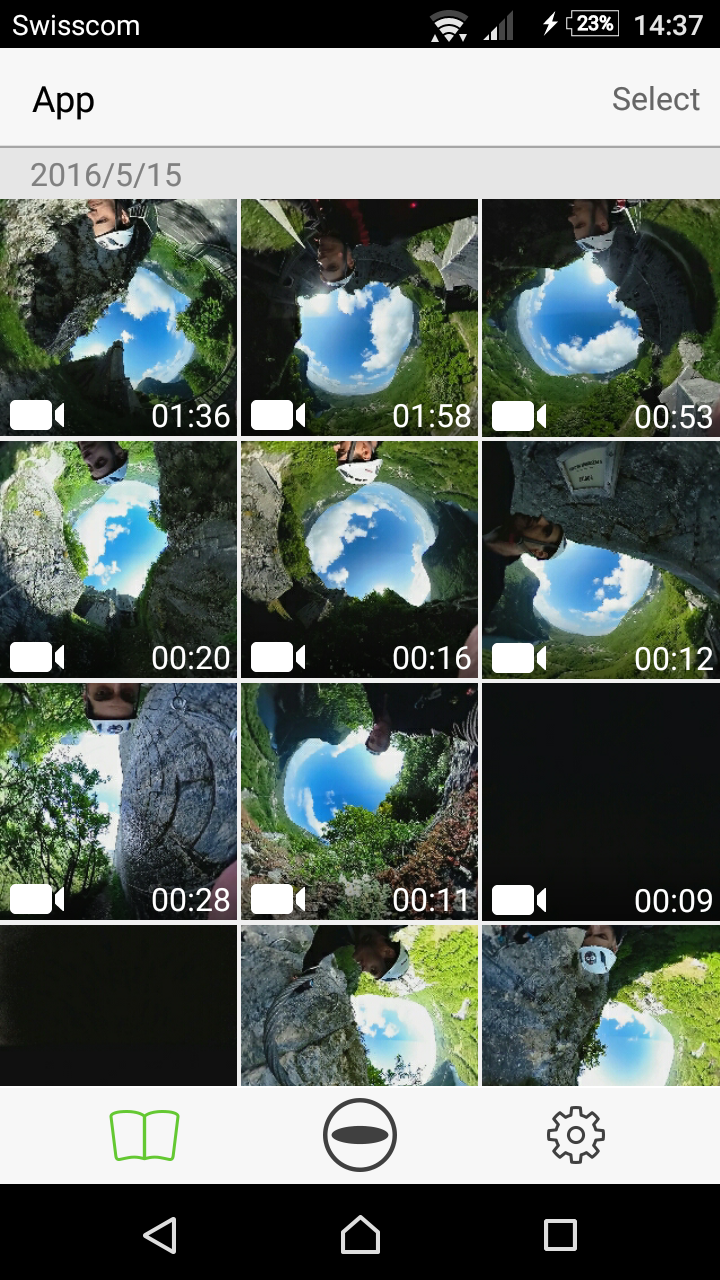
Vlogging on a Via Ferrata with the Theta S by Ricoh is not only feasible but interesting. Earlier today I went to the Via Ferrata du Fort L’écluse in the French Region of Ain. This Via Ferrata goes long the nice rock face next to the climb. The purpose of this video is to bring you with me so that you can experience the sounds of Via Ferrata without the climbing experience or a head for heights. The Theta S by Ricoh is a 360° camera with two lenses. One lens is looking at the person taking video and the other lens looks at what the holder of the camera sees. When the two signals are combined you can export the video as a 360 video to be shared. The device has a mini HDMI out, a USB port, enough memory for 45 minutes of video at 1920X1080 with a 30FPS shooting range. It is currently one of the more affordable and intuitive devices to use. You can keep it with you at all times and getting material ready for editing takes seconds. The beauty of such a simple and light solution is that it allows for a very quick turnaround time. [caption id=“attachment_2873” align=“aligncenter” width=“169”]You can review the footage instantly Reviewing footage is simple and intuitive[/caption] I was hanging off a cliff when I was taking my videos today but if you’re a normal person you will probably be sitting in a café or some stairs to review the footage. When device wifi is activated and when you download the app you can use your phone as a remote to take videos or pictures and even to watch back the video you have taken in 360° vision. If you’re not happy with the shot then you can repeat it until you are happy. This system is a simple, elegant and all in one solution that is quick and intuitive to use.
Rock Climbing in Virtual Reality

Rock Climbing in Virtual Reality has an interesting future because some people are afraid of heights, others don’t have the muscle tone to climb and yet more live too far away from climbing locations to enjoy the sport. Virtual reality is a great way of enabling people to get some of the sensations of rock climbing without the safety concerns. As I watched this video I was curious to see whether it was a passive experience and then noticed the playstation controller. That’s a nice enough way to go “rock climbing but it it was up to me then I would pair this with the HTC Vive and it’s related controllers. Ideally I would go a step further. I would develop a conveyor belt system, place it vertically and program it to put handholds where the climber has somewhere to grip. As he or she climbs they would place their weight on the hand hold and it would slide down as the person climbs. We have seen demonstrations of equipment that can emulate 3d shapes and textures. The challenge would be to take this from being flat on a table to being vertical and strong enough to hold someone’s weight. Tests should be carried out on near vertical and vertical “climbing routes” before being rotated to allow for the climbing of overhanging routes. You would definitely get a workout from such a configuration. Gamers would go from their current physiognomy to being toned and healthy. The next generation of gamers are going to be fit thanks to Virtual reality workouts. This could also be attempted for sports like Via Ferrata, via cordata and others. Via Ferrata is a simplified form of rock climbing and via cordata is walking around a nice landscape where safety gear is available to keep you safe in case of a slip or fall whilst hiking. I really look forward to when this gaming/fitness training experience comes of age.

Archery with the HTC Vive

Virtual Reality is a great opportunity to practice skills and keep fit at the same time. It’s fun to watch people play these immersive games and get carried away. In Holopoint you’re an archer shooting at targets and they shoot back at you. You need to dodge out of the way to avoid being hit. At first you’re given enough time to shoot and avoid the arrows but as you progress in the game you need to react faster and dodge more arrows. From level 10 onwards you’re shooting at Samurai warriors and dodging arrows from boxes. The game looks both fun and physical. This game looks as though it could be addictive. If I had an HTC Vive I think I would pull the cable so that it is hanging from the ceiling rather than from the headset down my back and on to the floor. From my experience of the HTC Vive in Crans Montana and from the comments he makes during the video it seems logical to get the cable out of the way. It would be a shame to trip and break the device or injure yourself. The beauty of VR is that the graphics don’t need to be photo realistic for the application to be fun. As with Altspace you’re immersed in an environment and you know that you can interact with objects and talk with people in other programs. At first I was unsure about socialising via Virtual reality but after experiencing it I changed my mind. You are in a virtual environment and you can play with objects and move towards and away from groups. A friend was playing basketball in Altspace and I had fun piling mugs of beer until they fell to the floor. Virtual reality is as much about the environment as it is about having fun. The ability to play in a virtual environment is entertaining. I look forward to seeing how these environments progress and become more realistic. I was thinking about how sailing and other simulators would be possible with such technology. That would be a lot of fun. It would make a change from car driving and flying games.

The Immersive Video Experience

  I was at the World Virtual Reality Forum in Crans Montana this weekend as a volunteer. During this time I was able to try many of the demonstrations and get a real feel for the potential of 360° and immersive videos. I was also able to listen to people comment on what they appreciated about the experiences and what they did not like.

Vulkane in 3D und 360

One of my favourite experiences was Vulkane in 3D und 360. I worked at this exhibit two out of the three days helping two people at a time every three minutes experience this. I had watched a number of videos before this one and when I watched this one I said Wow because the experience was so beautiful. The quality is excellent and there are some vistas that are spectacular. We are familiar with watching volcanic eruptions but with this experience we are watching the scene as if we are there. As the volcano erupts we can see the projectiles and follow their course through the sky. This is a novel experience for many of us.

Getting an audience to film screenings

Adam Aron, CEO of AMC recently made a generation of cinema non-goers angry with him when he said that he would allow texting to take place during projects. My generation, previous generations and the generations of the future complained on social media. Getting an audience to film screenings requires an understanding of what they prefer to do instead. In the “Golden Age” of my cinema going life I would go to the cinema up to three times a week. I went this frequently because I lived close to the cinema, because we had two GBP Tuesdays and because it was something to do when other people were not available. Over a period of months I went to see more than 90 films. A consequence of this habit was over-familiarity with the codes and conventions of mainstream cinema. Since that “golden age” I have seldom been back to the cinema. When you know everything that will happen in a film within the first 15 minutes you get bored. I know AMC through its television Series of which the Walking Dead is one. This is a series that I did binge watch when it was fresh and again when it was made available via netflix. Television series have better writers and better storylines than films. They also don’t overdo it with super hero rubbish and special effects. As these productions have storylines we care enough to watch one episode after another. Films fail to engage us in this manner. When I was in London I went to a few screenings. The screenings I usually went to in London were at the Front Line Club. You would watch a documentary about current affairs and there would be a panel to discussion to discuss what you had just seen. In Geneva I found that the graduate Institute has started to do the same thing. I regularly go to such events because I like to complement what I already know by watching interesting productions and then listening to questions and answers sessions and learning something new. Montagne en Scène is an example of what AMC should think of doing. They need to find and fund the production of films for niche markets. Montagne en Scène is an event where four mountain related films are projected to a specialist audience of mountain and sports enthusiasts. This niche usually relies on youtube and vimeo to find and share footage of their passions. By organising a special day these enthusiasts are encouraged to come to film screenings. AMC is competing against mobile phones, televisions, Virtual reality goggles, tablets and Video on Demand via the World Wide Web. what they need to do is lower the price and make it more convenient for people in contemporary culture. Having panel discussions at the end of a screening is one way of attracting people. Lowering the ticket price would be another way. If they stopped making CGI films with no story then I would start going to the cinema again. This complain extends to the crappy films currently available, at least in Switzerland on Netflix. If Netflix did not have television series I would have stopped paying for their service months ago. If you treat your customers/viewers like mature adults then there is a good chance that you will attract them to film screenings on a more regular basis.

Virtual Reality Advertising

At this moment in time Virtual Reality is an abstract notion for most people. It is easy to find news features and documentaries speaking about the potential of the medium. The video above is the most effective demonstration of Virtual Reality that I have seen so far. I like that they use a greenscreen to key in the environment that the guinea pigs are in. We are immersed in to the reality that they are seeing. It demonstrates not only the games and environments you could find yourself in but how it is a communal rather than solitary experience. This advert removes some of the stigma of virtual reality. From the 6th of May to the 8th of May 2016 a meeting will take place in Crans Montana Switzerland. It has the title of World Virtual Reality Forum.  “The World VR Forum is dedicated to advancing the virtual reality industry and culture.” Artists, documentary makers, news producers, architects, surgeons and an ever-expanding group of people will benefit from this technology. The video above helps us understand the intricacies of using something as simple as two hand held controllers. In two to three months the Music festival season will start with Caribana, Montreux Jazz, Paléo Festival and many other music festivals. During these events media outlets and artists love to give interviews to journalists to drive interest in their upcoming performance. For now we usually have two or more cameras. In some cases you have one wide shot of the room or the artists and the second camera is a close up of the artist as he speaks. This summer I expect that we will watch interviews in 360° video where we can turn and see the journalist asking questions and turn to face the artist when he answers. When a group of artists are interviewed you will be able to watch the antics whilst listening to what they are saying. You will watch the artists and the journalists smile and laugh. When I think of VR goggles I do not think so much about gaming as I think about documentary and television production. I like to think about how it could provide new opportunities for content producers to create interesting and immersive video content. “Their headsets were connected with the school campus more than 900 miles away in Okinawa, where the school’s headmaster spoke. The students were also treated to a 360 degree view of the campus inside the augmented reality.” (source) Google Streetview could provide live 360° vision of specific squares, St Marco in Venice, Notre Dame in Paris, St Peter’s in Rome or the market Square in Wroclaw. Imagine Google Street view when wearing a VR headset. VR headsets are being offered by a number of brands for all mobile phones and the number of cameras able to provide 360° video are growing in number. As both of these democratise the market so content creators will have more customers and more incentive to produce relevant content.

Virtual Reality Goggles and multicamera Production

I have worked with video cameras, from hi8 to MiniDV, Beta SP, SX, DVCAM, XDCAM, AVCHD and other formats. Cameras have grown and shrunk, controls have changed from manual to partially automated to fully automated. Television news and Studio camera productions have gone from three or four camera operators to needing a couple and then a single camera operator sitting in a side room with controls for all three cameras. Crane and jib moves are programmed so that the same action is performed at the start of each news program. Virtual Reality technology and Virtual reality headsets are going down in price. Apps provide mobile phone users with 360° videos in normal vision and 3D. The technology we use to watch 360° content and immerse ourselves in the VR world could be adapted and made suitable for multi-camera production. It would be nice for software to be written that moves the camera as we move our heads. This technology is already used by gunners flying in Apache helicopters. The point would be to adapt this technology to camera operating. I would manual controls for zoom and focus and a control  to lock off the camera once the desired shot is ready. Imagine how much simpler controlling drone and crane cameras would be. Imagine also how much nicer it will be for conference attendees, concert goers and UN delegates if a smaller remote controlled camera could be used. Camera operators often obscure people’s view. This technology would be less intrusive. Camera operators could sit rather than stand for hours at a time, barely able to move. VR goggles and the technology they contain should not be used just to consume a finished product but should instead be used as a creative/production tool. VR goggles and related tech could be used to simplify people’s work, to make it more intuitive. Multicamera production with VR goggles would reduce costs and make high-quality video coverage achievable even for modest budgets. The excuse for using a single webcam to Livestream an event will be gone making virtual attendance of events more enjoyable.

Video Editing in a virtual Reality environment

A few years ago I said that I would upgrade my mac book pro when apple came out with a dual display laptop where the keyboard is a touchscreen display that changes to suit the application in use. Two days ago I had a change of heart. I do not expect Apple to come out with such a device. I have set my sites on a different idea. An edit suite which requires VR goggles to use. The edit suite could be used either by standing people or sitting people. Turn your eyes to the left and you see the rushes. You would have a choice. The rushes could be shown as keyframes on a board or as film strips. Motion feedback gloves would be worn that provide tactile feedback. Double click and the selected clip appears in the player window. With current editing systems keyboard shortcuts are learned and memorised by editors to avoid using the mouse. In this case specific finger positions would be short cuts. You could trim, splice, insert, overwrite, make multiclips and more. Sound and vision could be faded as if using physical controls. Imagine multicamera editing in Final Cut VR. The setup would be like in an OB van except that you’re in an edit suite or in a park. You could even be sitting in the back seat of a car. The beauty of such a setup is that monitors and displays could eventually be removed from the desk to be replaced with goggles and a pair of gloves. This means that the same edit suite could have a virtual 64 channel audio mixing board for sound technicians, colour correction wheels for colour graders, vision mixing console for vision mixers and standard video editing controls for video editors. In theory we could go back to the jug/shuttle controls from linear editing days. I now look forward to seeing whether Avid, Apple or Adobe come out with the first virtual audiovisual creation suite. Imagine how immersive the experience would be. Enjoy the notion that this virtual environment will allow you to stand or sit down.