Vimeo

Watching independent film rather than mainstream cinema

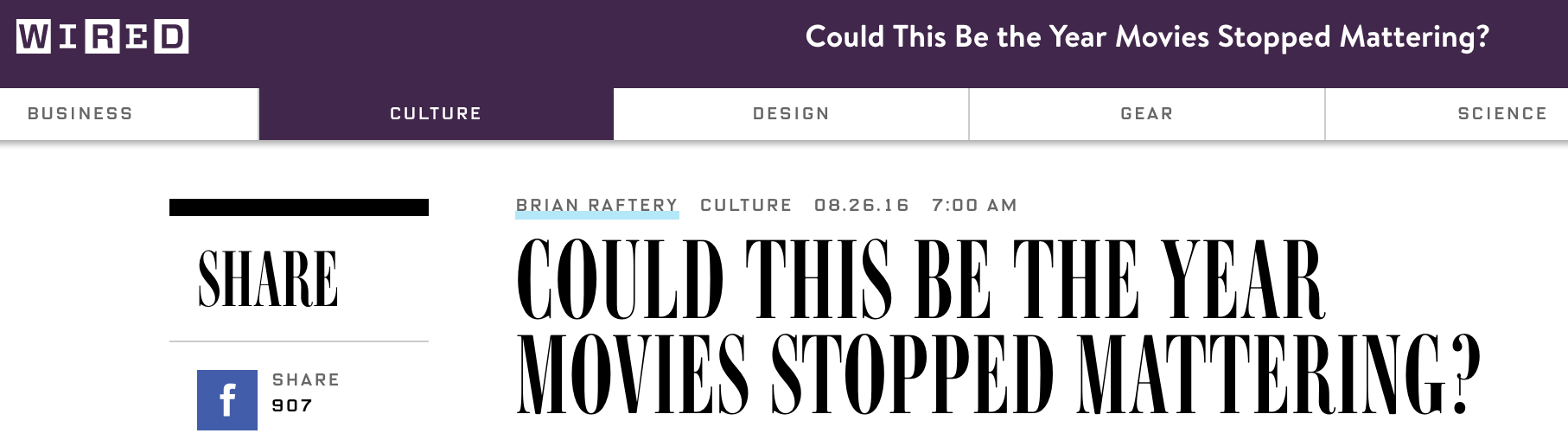
When I saw the Wired headline below I was happily going to say that I haven’t been to see a film at the cinema in years but that isn’t strictly true. As you have seen from my blog I have been an active appreciator of independent films. I was at FIFAD earlier this month and I was at the Montagne En Scène a few months ago. I have been to a few film screenings at the Graduate institute among other places. [caption id=“attachment_3335” align=“aligncenter” width=“300”]I have been to see quite a few films this year I have been to see quite a few films this year[/caption] I love watching good films and I love going to the cinema but at the moment there isn’t a single mainstream film that I want to see. Every single film is filled with CGI and fantasy and as I have joked about why would I spend 25 swiss francs on a film ticket to go to a film screen at a specific time when I could watch youtube gameplay videos and discover the story at the same time as the youtuber. Last week I decided to stop my netflix subscription for two reasons. The first reason is that the content is crap. As they have a selection of films that have recently been shown at the cinema there is nothing that makes me think “That’s what I want to spend the next 90 minutes of my life watching. Imagine if Netflix showed more extreme sports, adventure, environmental and other films. Imagine if they showed films that make us dream and aspire to more. Films need to be for other people than sci-fi geeks. They need to be for sports enthusiasts, for people that follow current affairs and for people that live in the real, rather than fictional world. When I was living in the South West of England I went to the cinema ninety times in 9 months and what burned out was not my passion for the cinema but my ability to watch the same story line over and over again. The lack of creativity and originality is destroying people’s desire to go to the cinema. I have no reason to go to Pathé or other cinema complexes around Geneva because they do not show the films that I want to see. They do not address my niche. Montagne en Scène, FIFAD and I think the Coupe Icare film festival fulfil my desire to watch films. They cover topics that I am either interested in passionate about. Les Icares du Cinema 2015 from coupeicare on Vimeo. Doesn’t the trailer for the film festival make you want to go? Don’t you want to watch people pushing themselves to the limit of their courage and endurance? I watch a trailer for an event like this and I definitely want to go. It fills my desire to challenge myself through the sports I do but also to see beautiful scenery and lanscapes. Why would I want to go and see CGI films when I can see extreme athletes challenge themselves and their equipment to the limits. Watch the video below. Coupe Icare 2016 from coupeicare on Vimeo. I watched this video at least twice and you see that whilst hollywood is filling its films with make believe the independent sector is documenting those with a real adventurous spirit. Imagine going to the event for the film festival and staying for the aerobatics. For years now the film industry has been re-hashing the same content with no appreciation of societal changes. As a result they fail to capture our imagination and our desire to spend money. They need to inject new blood and find new creative directions that will make us want to go to the multiplexes rather than independent events. I enjoy the multiplex experience but the content dissuades me.
Getting Up Getu - some impressive shots

Getting up Getu is short documentary climbing video about Alex Honnold and Felipe Camargo climbing a beautiful roof climb. The most spectacular aspect of this video is the size of the arch that they are climbing. In two or three shots you see the size of the rock formations compared to the climbers. The people look tiny. The rock formations that droop down from the ceiling look interesting. The climbing at this location ranges from 5a to 9c according to one source I skimmed through. There are 250 routes to choose from so this is ideal for a great number of climbers. This was the 2011 location for the Pezl Roctrip. Getu looks like a beautiful area in china with interesting rock formations, arches and much more. The video below provides you with a glimpse of what else there is to see in this region. It is in the Guizhou province of china and the nearby city is Anshun. Getu, China from Ryan Deboodt on Vimeo.

The pleasure of narrowcasting

Three things have made the pleasure of narrowcasting rather than broadcasting a reality. Broadcasting is finding something that as many people as possible are interested in watching. This is mass appeal television. European Football is one example, british rugby another, skiing another and tennis as a last one. Each of these has a large budget to spend because of the mass appeal of the content. It means that you can experiment with Ultra high definition, 3D broadcasts and more. In essence it is content that is easy to justify. Narrow casting is the opposite. Narrow casting is the opposite. It’s about providing content for a small number of people. This means less interest, less money and therefore less feasible. Early attempts at narrow casting include both cable television and community videos. The problem with cable television and community videos is that they are not on demand so unless you’re ready to watch the content at the time it is aired or the time when it available on VHS tape you missed it. Youtube, DailyMotion, Vimeo and other video distribution solutions started by allowing people to upload random clips with low production values. As interest grew and as people uploaded new content from pirated shows to pirated music, from home videos to more so the focus changed. I look at the early days of vlogging when iJustine streamed content live, Seesmic when we chatted with each other to webcam vloggers, game play videos and more. As these low brow content makers showed that they could amass an audience and as advertisers saw that they could generate an income so other people could come along. I recently noticed that Jay Leno has a show on youtube about his garage. We see him talk about a car per episode, around 25 minutes a piece. In these shows he speaks at a relaxed normal pace. We see him talk about cars. We see him show content from photo books and in general we get the feel that we used to get from browsing through magazines and books like in the good old days. With Video on Demand services like youtube we are coming to a new age in video content where the content we can browse through and watch documentaries like we used to browse through newspapers, magazines and books. We can learn about niche topics in a medium that would have been prohibitively expensive in the past.

Springwatch - Some Swiss bees

Spring is finally back and the fun sports are about to start again. Via Ferrata, Rock climbing, hiking and other sports will be possible and we will see what new places I explore. While waiting for the season to start properly I took some time to film bees pollinating a form of apple tree. The images were captured with a Sony PMW-200. This camera records high quality images. Springwatch - some swiss bees from Mainvision on Vimeo. This summer I will work on projects and share them.I hope to realise my documentary about via ferrata at last. I have acquired some new skills but need to find people with whom to collaborate with.

Spy-cam wildlife filmmaking

Spy-cam wildlife filmmaking is an interesting discipline. It builds upon the decades of innovation that the documentary film genre has built upon. From the earliest images by the Lumière brothers of the workers at a factory to the development of film editing by Eisenstein and Dziva Vertov demonstrated by “The Man With the Movie Camera to sync sound with the Crystal sound system used by Jean Rouch for Chronique d’un été. The BBC is seen as the leading example of high quality television programming and this has been the case for decades. The Natural History Unit is responsible for some of the best wildlife documentary films and series and with good reason. They adopt the latest technology, hire crews for months or even years at a time, to capture nature’s spectacle and beauty, and bring it to living rooms around the world. Sensory: BBC Wildlife Director John Downer & the technology of ‘spy-cam’ filmmaking from Getty Images on Vimeo. This attention to detail and this dedication to getting the best images has resulted in some of the best looking documentaries around. the Blue Planet Series, the Planet Earth series, Life and others have provided people with what I like to call a video encyclopaedia of the natural world. The technological innovation that we see in the video above demonstrates how animals and behaviour that we had seen through a tele-lens can now be seen up close and with as natural a behaviour as possible. Almost every book I have read about the documentary genre speaks about capturing life with as little alteration of natural behaviour as possible. This technology is making that wish a more realistic goal.

Bragi - self contained in ear audio player

BRAGI - The Dash – Wireless Smart In Ear Headphones from BRAGI on Vimeo. I enjoy cycling, running, climbing and via Ferrata so this type of device is well suited to my needs. The price is not. At 300 USD it is an iPod shuffle replacement at its core. From what I understand The Dash can track steps, heart rate and duration of sports so in theory you can go without a sports watch, sports tracker or mobile phone. In practice, I never leave the house without my phone. I do see it filling a swimming niche. Most mobile phones are not IP68 certified. If this device is IP 68 certified (I could not find information on the website) then I see it being especially interesting for swimmers. According to their website they can be used for four hours in between charges but charge time is two hours. They will last through most workouts. The limitations I see to this device are first and foremost the price. I don’t want to pay 300 USD for something that I am likely to lose. I listen to podcasts and audio books and like to have several on my devices at all times. Both my mobile phone and iPod classic fill these roles with ease. When the price for these devices descends to 200 USD I will be willing to buy a set. I would also like to have either two sets of earphones or a charge time of just an hour rather than two. They say that the app is coming soon. As an audiobook and podcast listener, I want to save my progress and bookmark interesting passages. I would like to see this incorporated to the gestures that control the device.

Film and Video archiving

Film is Fragile - Film needs your help! | BFI Trailer from BFI on Vimeo.

Recently I spent more than a year working as a video archivist for the United Nations High Commissioner for Refugees. During this time I digitised several decades of documentary films and news stories. In the process I went from knowing very little about refugees to being a better informed member of the public. We can learn a lot from watching old films and old television series. We can also learn a lot about society. One documentary I watched was about the Bamboo city. It looked at refugees living there and tried to understand why those trying for asylum were refused. It followed their skills training, language training and finally their acceptance to host countries. Another documentary I watched was about the 1980s Afghan war when the Soviets went in to try to win over the country. It was fascinating to watch how one generation of Soviets and then a generation of Americans met the same challenges and trials. Le Monde Du Silence, film by Jacques Yves Cousteau from 1956 is a fascinating documentary because of it’s reflections of what people knew of the seas and oceans at the birth of self contained underwater breathing apparatus (SCUBA) exploration. This documentary as well as all Jacques Yves Cousteau documentaries are an interesting glimpse back to what people were learning about and discovering. It allows us to study and understand the way in which attitudes and understandings have progressed over the decades. I watched Magnum PI and it’s interesting to see a pre-mobile phone society. It’s interesting to watch these series and see the world of my youth. Another series of interest is Friends because of how seldom we see mobile phones at least at the beginning of the series. We see how society was in the 1990s. If we watch this series in parallel with Big Bang Theory we see how much society has changed. We see how knowledge has progressed. We need to keep the film and video heritage alive and well. We, as a generation must work to preserve our film and video heritage. We must either donate our time or the funds to help preserve our heritage. In so doing books about film and television history are not just books. They are interactive. When I was reading about Eisenstein and Dziga Vertov these films were on film or VHS tapes and hard to find. Today they are available on demand. If we continue to digitise and preserve our cultural heritage then future generations will see and understand how ideas and art forms have progressed over the decades and eventually centuries.

Le Sentier des Toblerones

Le Sentier des Toblerones Toblerones Walk from Mainvision on Vimeo. Hidden among the trees in the Canton de Vaud you can find concrete blocks put there as a defensive line to slow down invading armies. The concrete blocks have a similar shape to chocolate Toblerones. There is a hiking trail that you can follow from Bassin down to the lake side. Along the way you can find concrete bunkers camouflaged as houses.