Via Ferrata

360 photos of Via Ferrata

Yesterday I was up above Leysin climbing the Tour D’Aï via Ferrata. It was an opportunity for me to take 360 photos of Via Ferrata. The beauty of panoramic pictures is that they provide you 360° of vision both vertically and horizontally. It means that you can get a sense of size and scale. You can look at the person exploring the via ferrata and how precarious their situation is as easily as you can admire the beauty of the landscape. [vrview img=“http://www.main-vision.com/richard/blog/wp-content/uploads/2016/07/R0011307_20160701130638.jpg” pimg=“http://www.main-vision.com/richard/blog/wp-content/uploads/2016/07/R0011307_20160701130638.jpg” width=“500” height=“400” ] Another great aspect to 360° photos is that you can show specific bits of via ferrata and show where the challenging bits are. “Here is where the via ferrata is overhanging” so that you can assess whether you have the strength and courage to try that section or “Here is how high up you are” and so you get a sense of whether you would be paralysed with fear or enjoy yourself. [vrview img=“http://www.main-vision.com/richard/blog/wp-content/uploads/2016/07/R0011321_20160701133926.jpg” pimg=“http://www.main-vision.com/richard/blog/wp-content/uploads/2016/07/R0011321_20160701133926.jpg” width=“500” height=“400” ] Most via ferrata are like the one that you see in these images. You have what I call staples, pedals and occasionally direct contact with the rocks. In other places you have spikes or you have to pull yourself up along the cable. With these images you see how well equipped the via ferrata is and you are not going in to the unknown. This is good when taking less experienced people. A side effect of 360 pictures is that you capture a self portrait of yourself in situ over and over again. It is by nature of the medium rather than desire.
A Chinese Via Ferrata of sorts

School children in the Chinese Sichuan province need to climb up a via ferrata of sorts to get to school. As I watch this footage it makes me think of the Ladders of Death Via Ferrata between France and Switzerland where smugglers would transport contraband between these countries. When I watch this footage I believe that it would be relatively easy for the Chinese government to get some European Via ferrata equipment specialists to create a via ferrata and safety gear adapted for young children. In Europe Via ferrata are equipped with “pig’s tail” metal loops through which safety ropes can be threaded. These make it possible to do via ferrata with younger children. The drawback to via ferrata equipment is that it has certain weight requirements. They are designed for people who weigh between 50-110 kg so if you are too light the “parachute” will not be activated and this can lead to injury. I like this video from an ethnographic and historical context because it shows us a glimpse of what the infancy of via ferrata was like. It shows us the improvised ladders, agile people climbing on exposed rock and more. We see that the youngest person is kept relatively safe by his father and a rope in case of a slip or fall. In the news item they speak about developing tourism. The parents live in this remote village of 72 people because the farmland is arable. With the development of tourism the path to school could be improved and made safer. If they develop via ferrata tourism as we see in Europe, the Americas, Asia and New Zealand they could have an additional form of income. I know that I could be tempted to try this as a via ferrata if and when they re-equip it. It’s a nice way to see the landscape and a good reason to visit new places.

Vlogging on a Via Ferrata with the Theta S

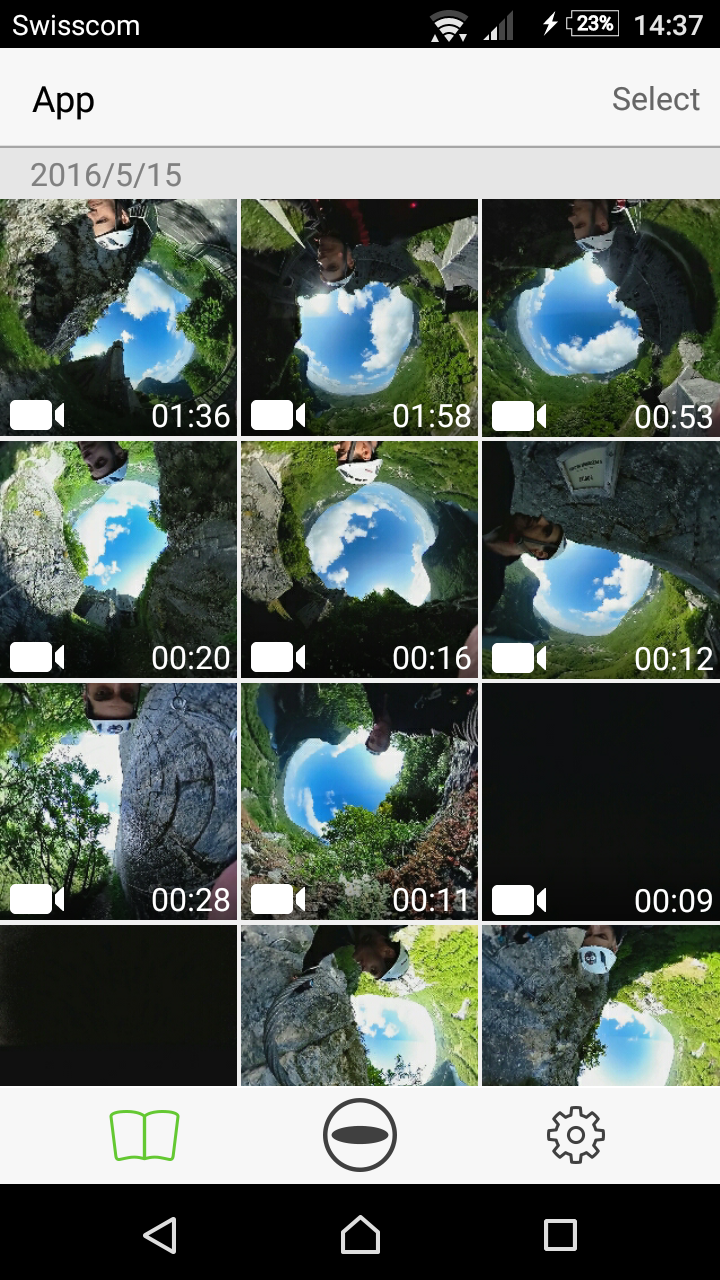
Vlogging on a Via Ferrata with the Theta S by Ricoh is not only feasible but interesting. Earlier today I went to the Via Ferrata du Fort L’écluse in the French Region of Ain. This Via Ferrata goes long the nice rock face next to the climb. The purpose of this video is to bring you with me so that you can experience the sounds of Via Ferrata without the climbing experience or a head for heights. The Theta S by Ricoh is a 360° camera with two lenses. One lens is looking at the person taking video and the other lens looks at what the holder of the camera sees. When the two signals are combined you can export the video as a 360 video to be shared. The device has a mini HDMI out, a USB port, enough memory for 45 minutes of video at 1920X1080 with a 30FPS shooting range. It is currently one of the more affordable and intuitive devices to use. You can keep it with you at all times and getting material ready for editing takes seconds. The beauty of such a simple and light solution is that it allows for a very quick turnaround time. [caption id=“attachment_2873” align=“aligncenter” width=“169”]You can review the footage instantly Reviewing footage is simple and intuitive[/caption] I was hanging off a cliff when I was taking my videos today but if you’re a normal person you will probably be sitting in a café or some stairs to review the footage. When device wifi is activated and when you download the app you can use your phone as a remote to take videos or pictures and even to watch back the video you have taken in 360° vision. If you’re not happy with the shot then you can repeat it until you are happy. This system is a simple, elegant and all in one solution that is quick and intuitive to use.

Rock Climbing in Virtual Reality

Rock Climbing in Virtual Reality has an interesting future because some people are afraid of heights, others don’t have the muscle tone to climb and yet more live too far away from climbing locations to enjoy the sport. Virtual reality is a great way of enabling people to get some of the sensations of rock climbing without the safety concerns. As I watched this video I was curious to see whether it was a passive experience and then noticed the playstation controller. That’s a nice enough way to go “rock climbing but it it was up to me then I would pair this with the HTC Vive and it’s related controllers. Ideally I would go a step further. I would develop a conveyor belt system, place it vertically and program it to put handholds where the climber has somewhere to grip. As he or she climbs they would place their weight on the hand hold and it would slide down as the person climbs. We have seen demonstrations of equipment that can emulate 3d shapes and textures. The challenge would be to take this from being flat on a table to being vertical and strong enough to hold someone’s weight. Tests should be carried out on near vertical and vertical “climbing routes” before being rotated to allow for the climbing of overhanging routes. You would definitely get a workout from such a configuration. Gamers would go from their current physiognomy to being toned and healthy. The next generation of gamers are going to be fit thanks to Virtual reality workouts. This could also be attempted for sports like Via Ferrata, via cordata and others. Via Ferrata is a simplified form of rock climbing and via cordata is walking around a nice landscape where safety gear is available to keep you safe in case of a slip or fall whilst hiking. I really look forward to when this gaming/fitness training experience comes of age.

Spy-cam wildlife filmmaking

Spy-cam wildlife filmmaking is an interesting discipline. It builds upon the decades of innovation that the documentary film genre has built upon. From the earliest images by the Lumière brothers of the workers at a factory to the development of film editing by Eisenstein and Dziva Vertov demonstrated by “The Man With the Movie Camera to sync sound with the Crystal sound system used by Jean Rouch for Chronique d’un été. The BBC is seen as the leading example of high quality television programming and this has been the case for decades. The Natural History Unit is responsible for some of the best wildlife documentary films and series and with good reason. They adopt the latest technology, hire crews for months or even years at a time, to capture nature’s spectacle and beauty, and bring it to living rooms around the world. Sensory: BBC Wildlife Director John Downer & the technology of ‘spy-cam’ filmmaking from Getty Images on Vimeo. This attention to detail and this dedication to getting the best images has resulted in some of the best looking documentaries around. the Blue Planet Series, the Planet Earth series, Life and others have provided people with what I like to call a video encyclopaedia of the natural world. The technological innovation that we see in the video above demonstrates how animals and behaviour that we had seen through a tele-lens can now be seen up close and with as natural a behaviour as possible. Almost every book I have read about the documentary genre speaks about capturing life with as little alteration of natural behaviour as possible. This technology is making that wish a more realistic goal.

The start of the Via Ferrata Season

Via Ferrata has been one of my favourite sports for five seasons and yesterday marked the first outdoor climb of the season. It took place at the Val de Tière near Champery in Switzerland. [gallery ids=“2822,2823,2824,2825,2826”] What made this experience special was arriving at the car park near the Telepherique and seeing hundreds of cars parked. Yesterday marked the end of the ski season and with the end of the ski season the mountains are abandoned by the masses. The mountains are then left to people who love the mountains when we see rocks, plants and more. The Val de Tière Via Ferrata (VF) is an easy one for beginners but don’t let that fool you. Just because people say that it is easy does not mean that beginners won’t be petrified. As a precaution make sure you go with someone who knows the VF well and is ready to offer assistance to those who get scared. Yesterday one person was afraid. He was really clinging to the bars and his arms were always tense. He was afraid and tense and this tired him. As I had a spare drink I offered it to him, so that he could get some strength and re-hydrate himself. He made it to the top. Via Ferrata are not as easy as climbing a ladder and fear does play a very important role. Always go with someone who knows Via Ferrata well and make sure that you are with a patient and attentive person. People underestimate their ability on via ferrata and then get stuck. When a person gets stuck six to eight rescuers are needed to assist and they sometimes have to drive a big distance. If you have never rock climbed and if you have never tried Via ferrata or canyoning then make sure to go with people that will help calm you down and build up your confidence. If you take less experienced people make sure that you have spare food and drink. If someone is distressed this small anticipation may provide them with the strength to continue.

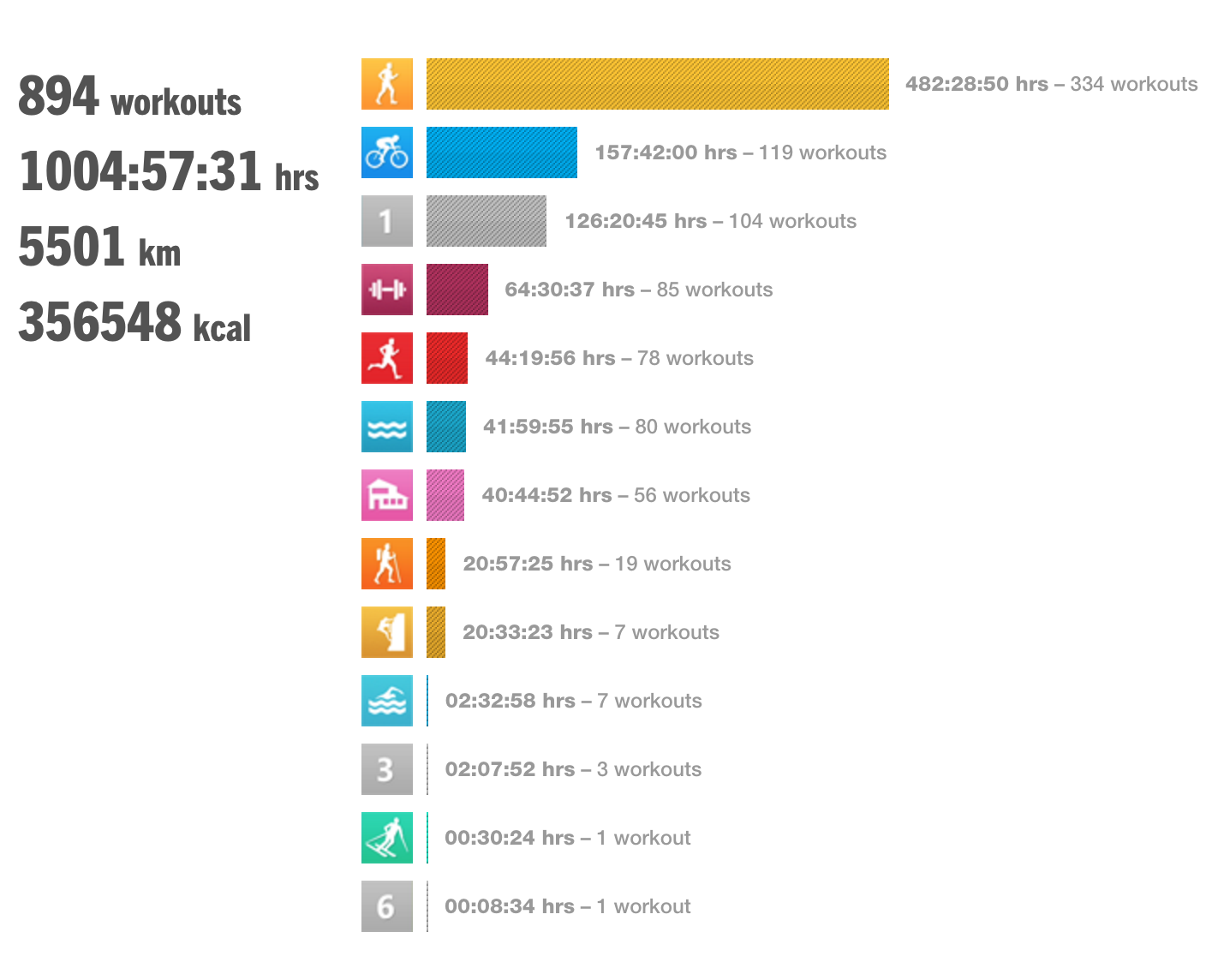
Sports tracker: 1004 hours tracked across multiple devices over the years.

For years now I have been tracking my sports activities with sports tracker on a variety of mobile phones, dive computers and sports tracking watches. I have gone canyoning, hiking, swimming, skiing, snowboarding, climbing, to do via ferrata, explored caves and trained indoors. In that time I have not had too many injuries and I have taken hundreds, if not thousands of photographs. [caption id=“attachment_2809” align=“aligncenter” width=“300”]1000hrs with sports tracker I have tracked more than 1000 hours[/caption] These activities have been in France, Spain, Switzerland, Italy, England, Poland and maybe in or two countries that I have forgotten about. Sports tracking has progressed enormously since I started tracking activities. In the beginning I was using the N95 8gb and the battery lasted for about an hour. I then switched to various iphones and android devices before deciding that mobile phones were crap. That’s when I moved over to the Suunto Ambit 2 and later Suunto Ambit 3 devices. Since then I have been very happy tracking my physical activities. One key step was when Suunto and Sports tracker decided to share data between their services. At this moment I could track with the Suunto Ambit 3 and share to Sports tracker without four or six steps per activity. Since then the service has been reliable.

Via Ferrata du Diable - Aussois

The Barrière de l’Esseillon are a line of fortifications two hundred years old and capable of holding two thousand soldiers in total.The fort Victor-Emmanuel is still standing and in it’s day could hold up to one thousand five hundred troops. This fort overlooks the via Ferrata. Some drone shots of the region in winter The Via Ferata du Diable is a series of via ferrata routes located around a bridge called Le Pont du Diable (Bridge of the Devil) which crosses the river L’arc (The Bow). This set of via ferrata varies from two easier ones that are suitable for children to four via ferrata that are suitable for various skill levels as long as you are not afraid of heights. The last one is going to challenge your courage and stamina because it is high off the ground and there are overhangs. The via ferrata are numbered so if you do them then do 6 followed by 3, then walk back and do four and five so that you complete a loop without back tracking. If you want to do the seventh then be ready to be high off the valley floor, to cross a monkey bridge, a nepalese bridge and a more conventional final bridge. There is an escape route but by this point you might as well finish the via ferrata and walk back. [gallery columns=“4” ids=“2573,2574,2575,2576,2577,2578,2579,2580,2581,2582,2583,2586,2587,2588,2589,2590,2591,2592,2593,2594,2595,2596,2597,2598,2599,2600”]

Switzerland, Fitness centres and the mountains

For three years I was a fitness club member. I loved going to the gym up to three times a week when possible. I loved training so much that I bought apps and devices to track my progress. Any time that I could not spend three sessions a week at the gym I felt disappointed. That passion, when you are in full time work can be hard to keep active. I tried going to the gym at 6am and I tried going after work but the habit never picked up. In Switzerland fitness memberships can vary from 700-900 CHF per year to over 1200 CHF per year depending on the membership perks you take. If you go to the gym 52 times a year that’s 23 CHF per session. If you go twice a week it’s reduced to just 11 CHF per week. If you go three times a week it’s 7 CHF per session. In theory this is a reasonable price. It’s less than a week’s pay for most professionals. In practice you want to justify the expense. You want to go to the gym when you have time. This means weekends, evenings and on public holidays. I was often frustrated to have free time but for the gym to be closed. I would love to see gyms that take your outdoor sporting passions in to account. Running and cycling are already somewhat covered in the lac Léman region of Switzerland. What I would like to see next are ski days, via ferrata excursions and canyoning within the club. During week days and when the weather is bad you would train in the fitness centre. As soon as summer weekends and holidays would allow then as a fitness centre you would enjoy the great outdoors. I see through Glocals and facebook groups that the interest to do activities in groups is there. Fitness centres could attract a younger demographic to join. I love physical fitness and I love exercise. If I lived in a city like London or Paris I’d be happy to sit in a gym and train. I’d have filtered air and less traffic to contend with. As I live in the Swiss countryside though I want to take full advantage of what nature has to offer. When I find a fitness club that offers discounted canyoning, waterskiing and other activities, and subsidised via ferrata and ski days then I will rejoin.

Fear and Strength in Via Ferrata

Fear and Strength in Via Ferrata play an important role. Fear drains us of energy. In Rock climbing this is fine. If you run out of energy you abseil down and you call it a day. In Via Ferrata when you run out of energy you are stuck on a rock face and people usually do not have the required safety equipment to help you out of the situation. It is for this reason that we read so frequently about rescues on via ferratas. I read that at fort l’écluse there have been four rescues this year, at Saillon there have been a few and in Bellevaux there may have been as many as ten. The point of via ferratas is that anyone can practice them. In theory once you get the harness, the y-combinator and helmet you are ready to climb. In practice you need to take several things in to account. Via Ferrata are graded according to three factors. These are Equipment, Height off the ground and physicality. Some via ferrata are well equipped and some leave you to improvise hand holds and foot holds on the cliff face. You also need to trust your own equipment. This does take some time. Height makes us afraid and our fear tenses the body. When the body is tense it uses a lot of energy. You stay closer to the rock and you use your arms to raise yourself whilst staying as close to the rock as possible. Through practice I have seen my confidence grow and in the process my technique has evolved and adapted. I often keep my arms straight and pivot about my hand as I push upwards with my legs. In so doing I climb fast and without burning energy. I can save energy because my fear has faded over the years. Whilst a beginner will try to keep their centre of gravity as close as possible to the rock I do the opposite. I swing out and up with every step. It means that I save energy for the overhangs. Two days ago someone who was afraid, who had far less experience was using his arms rather than his legs. Arms have tiny muscles compared to legs so they tire much sooner. In rock climbing if you make mistake you can usually be lowered back to the ground and within a minute or two the incident is over. In Via ferrata you do not have this luxury. In Via Ferrata when you start to get tired you need to continue. If you can’t continue then there are three options. The first is to call in a helicopter to take you off the cliff, the second is for a mountain response team to come and assist you and the third option is self rescue. For the latter I mean a group rescue. In the first two cases these are trained professionals who will resolve the incident relatively quickly. Always climb with people more experienced than you as they can help you. In one rescue scenario a person ran out of strength and let go just metres from the end. In this case knots were put in a rope so that the person could climb the rope as if it was a ladder. In another case a rope was used as a counter-weight where the distressed climber had to climb and two of us were supporting the weight as we were given slack. This is not ideal as it requires a lot of strength if the person being helped is exhausted. In the third case a rope and pulley system was used. In this case the force exerted was tripled and the rope was longer. It took just one person for this rescue. When we saw with what ease someone could be rescued we decided we needed the same equipment and to get proper training. Via Ferrata is a fun and exciting sport that brings you to beautiful landscapes and it is easy to assume that you can make it from point A to point B. People should take the time to assess their level of strength and stamina before starting. They should also rest when they have the opportunity. The problem with fear is that it is a positive feedback loop. The more afraid you are and the more your muscles tense, the tenser you are the more tired you are and the more afraid you are. Knowing when to take a mental and physical break in via ferrata is essential. Take breaks to drink and eat something before you get tired. Clear your mind and relax before you continue. It is better to take twice the recommended time than to run out of energy half way through a Via Ferrata.