Twitter

Keeping Twitter Private

Twitter has three options. You can tweet to the world without barriers and anyone can read and respond. This is great when you want to grow your network and have conversations. The second option is to send DMs to specific individuals or groups (if I remember correctly). The third option is to make your account private. The only people can read your tweets are the people who were following you when you made the account private.

Twitter Threads and Blogging

Twitter threads and blogging are both free but whereas with one you need to click to read the continuation and it’s hard to print the other is self contained and easily shareable.

I see twitter threads, that as twitter threads are a waste of time on a conversational channel but would be ideal for a blog post. Imagine that you combine two or three tweets. That length would justify a blog post.

Twitter Ethics and the Olympics

Sports and live events are Twitter Cash cows, as a result of which the will of those contributing to twitter financially is given priority. I have seen two or three tweets about the speed with which olympic anim gifs and other content is removed. In one case I saw that content is pulled down within minutes. On the other side of the equation is bullying and harassment of ordinary people on twitter. In the cases where people are bullied or harassed twitter is passive, letting people deal with the fallout from flame wars and other unpleasant moments. Twitter was a social network for the first year or two but since then it has become a broadcast network. It focuses on the people that bring it money rather than attention. It focuses on verifying accounts with hundreds of thousands or even millions of viewers to serve its own interests. Users like you or I are not that important. There is the popular phrase that “people who complain still want to do business with you”. I stopped complaining about twitter years ago. I deleted my first account and stopped using the service. If you are not happy with the way twitter behaves and if you are not happy with the preferential treatment that it offers its sponsors then the simple solution is to reduce the amount of time you give twitter. When twitter was a social network you were justified in keeping the twitter application open on your phone and laptop but since it has become more of an RSS aggregator that devotion of time has become worthless. If you’re not happy with twitter spend less time on the network. Use it as infrequently as you use the bath in your home. We take daily showers because it takes less time and because there is less waste. The same is true of twitter. Twitter is a social network that needs eyeballs to justify charging its clients money. Broadcasters and the IOC are clients. If you’re on twitter complaining you are a pair of eyeballs. You are the attention they are looking for. If you are unhappy and abandon the network that pair of eyeballs is gone and their revenue stream declines. When enough people affect their bottom line in this manner they are forced to change. Twitter is easy to replace today for the simple reason that it became a news aggregator. There are dozens, if not hundreds of apps and social networks for the sharing of news, information and other content. Twitter is no longer alone. If enough people move away then they will be forced to change. We are the commodity. The audience justifies the fees. If the audience is gone then the fees are unjustified. Twitter was meant to keep us happy and it has failed. That is the reason for which I tweeted 70,000 times in the first two years and less than three thousand times in the last five years.

IFTTT - Instagram to Twitter

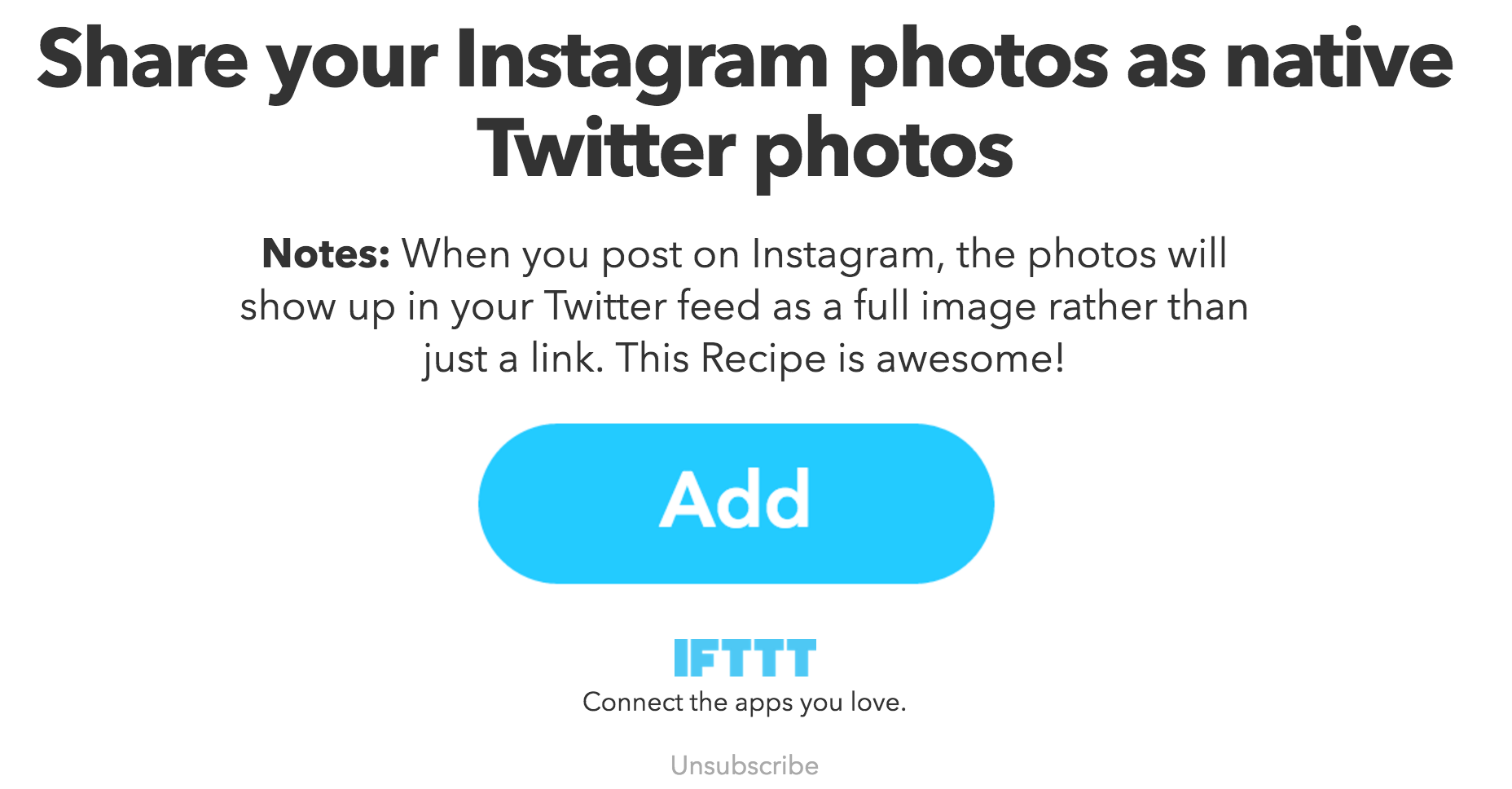
Instagram is still a healthy social network. It still finds an engaged group of users who want to share their adventures, meals, friendships and more with other users. Some of them love sharing selfies and others share beautiful landscapes. This keeps the network vibrant and young. Twitter on the other hand has neutralised peoples’ passion and engagement with the site. They wanted to become google reader, they wanted mass following of key accounts, they wanted to neutralise the social, conversational aspect and they have succeeded in their goal so effectively that now an IFTTT rule reduces the need to visit twitter. [caption id=“attachment_2980” align=“aligncenter” width=“660”]IFTTT Instagram twitter Which network do you prioritise[/caption] When you share your instagram photos as native twitter photos you are hiding that you are disengaged from Twitter. By hiding this disengagement from the social network you are hiding that you may not respond to replies, mentions etc. By not responding to those interactions you are negating the purpose of your presence on the social network. [caption id=“attachment_2979” align=“aligncenter” width=“660”]Twitter declines further The once social network Twitter continues to decline[/caption] When you fail to interact directly with websites such as Twitter you perpetuate the notion that twitter is a place where bots interact with bots because humans are no longer present. When humans are gone, when interactions between users no longer take place then what remains of the “social network”? Two hundred and ninety six thousand people have added this recipe to their IFTTT accounts. A quarter of a million people have chosen to spend time on Instagram rather than twitter. For this reason it makes sense to share pictures via Instagram. We will see your instagram account and we can start following it. In so doing we spend our time more effectively. Instagram still has a future. If you post to the networks that you want to use there is a good opportunity that others will want the same. Lets cut out twitter. ;-)

My love/hate relationship with twitter turns Ten

I have been active on the World Wide Web for two decades, two thirds of my life. Half of that time has been spent as a twitter  user. I was among the first to use the service and I saw it go from being a curiousity to being the most popular conversation tool around. When twitter was young the iPhone was in it’s infancy and data plans did not exist. As a result it was SMS based. The SMS idea was short lived as it ended up costing the twitter founders too much. Twitter owes an immense debt of gratitude to Apple, the iPhone and the shift towards mobile data plans somewhere other than Finland. When we were Twitter infants, when we were discovering the network and thinking of how to use it we were stuck at a computer and dependent on wifi and power sockets. If we left the house we missed on the conversation. Twitter at the time was a compelling network, especially since I was lucky enough to live in London during the golden age of Twitter. Twitter is a fantastic and compelling social network that has the wrong people affecting its feature. Marketers, public relations professionals, investors and other groups are too busy trying to push content to people rather than attract people. Yesterday afternoon I came across the term “Organic Social media” in relation to Instagram’s shift from a reverse chronological timeline to an algorithm driven timeline. A shift in the definition of social media has taken place. A decade ago social media implied that people were sharing content and commenting on it. They were making statements and friends and colleagues would comment conversationally. Marketers et al have destroyed the conversation and shifted everything towards an “I am the best so look at me” fed by likes, comments, shares and other tricks. As Twitter turns ten years old I grow curious about the future of friendships and online conversations. I question whether social media landscapes will become as unfriendly to introverts as bars in the physical world. Will social media become the place where the most conventionally appealing individuals thrive?

Reactions - What if Twitter died

You can tell when someone joins a social network by what they think the network is for. I joined twitter in 2006. No one knew what the network was best at, eventually everyone decided to use it as a conversation tool. When people understood how dynamic conversations could be the network grew. The author of “What if Twitter Died“wrote this: “it can’t seem to stretch beyond its celebrity, celebrity follower and tech roots. If you aren’t into celebrities or the tech industry, Twitter just isn’t that appealing, especially given all the other options for online social interactions.” It is clear from this writer’s post that he has not been with twitter since it’s earliest days. His twitter profile indicated that he arrived in 2010. That’s up to two years after the golden age of twitter ended. My previous posts have explored this topic in depth. While social media focus on marketers and public relations professionals I will keep blogging. It allows me to express myself without providing content for platforms that have destroyed the social dimension.

Conversational Social Networks

Ben Thomspon wrote, “How Facebook Squashed Twitter”.  The article looks at social networks from a marketing point of view. I like conversational social networks. Social networks by their very name are for conversations. They are about connections and they are about friendship, collaboration and more. 

In its Golden age twitter was a social network to establish new friendships with people we had yet to meet. It was a great tool, especially in places like London where the community of users was big enough to be interesting. Facebook, on the other hand, was a network of school friends, university friends and eventually colleagues. Facebook was more of an interactive yearbook.

Vanity fair is wrong to label Zuck as the top disruptor

Zuckerberg Tops Vanity Fair’s 2015 List of Disruptors Every successful social network first establishes a friendship network where a tight knit group of people interact with each other on a very frequent basis. In the case of facebook it was uni friends interacting with uni friends from the same campus. On twitter it was people in the same time zone conversing with people in the same city as themselves. It eventually led to face to face meetings and a new network of recognised friends. The same can be said of Seesmic when it was about “Join the Video conversation”. Notice my avatar… It’s the seesmic racoon. :-) Zuck wasn’t a disruptor or genius so much as the right person in the right place at the right time. Nothing he did was innovative. He just packaged it effectively. As a side note I have noticed that over a number of years the social aspect of twitter has suffered. It no longer feels like a social social network. it feels more like Google Reader. it’s amusing to see how social networks evolve and revolve from one type of network to another depending on what people want- Mark Zuckerberg Tops the 2015 New Establishment List—and Snags the October Cover! I remember when there were dozens of RSS aggregators for the sharing and distribution of blog articles. Over time traditional sources used the same technology. Google Reader and Google News became good sources for getting news stories and information. Facebook and twitter, social networks, decided that conversations were a waste of time and so encouraged their networks to be used as news aggregators. Recently Facebook reached the billion user daily mark. Amusingly this happened when the social network is at it’s weakest. It’s Unique Selling Point, connecting friends, has been lost. I went back to blogging because I grew tired of the rubbish being shared on twitter, facebook and other social networks. For years I insisted that social networks were a great way of meeting new friends and finding new business opportunities but as everyone overdid it with followers so the conversation and personal connections decreased. In the article they state that “Facebook chairman and C.E.O.Mark Zuckerberg has struck deals with _The New York Times_and BuzzFeed to publish articles directly into users’ pages.” I don’t go to facebook for news. I use the NYtimes app, I use Google News, I use news360, scoopinion and other applications. I use the applications because I found the condescending and sensationalist tone used by facebook marketers was offensive. We are a generation of university graduates on a university social network being treated as if we were primary school students. I don’t appreciate it. I also don’t appreciate the multiple posting of the same articles and tweets in timelines both on twitter and facebook. In theory twitter is an app that you keep open and monitor throughout the day. If something has to be posted several times then congrats on having such a disengaged audience. ;-).

is twitter changing your blogging habits? - A 2008 response

Yes and no. Twitter is replacing instant messaging and chatrooms. It’s an open method by which for people to communicate instantly with others. It’s also about the overheard conversation although that term has disappeared. What does “overheard” mean? Well simply that whenever two people discuss a topic hundreds of people are following this conversation and when they decide they have an opinion they can cut in. They do have that 140 character limit though, so they need to get to the point is efficiently as possible. When that isn’t possible then they can do the next best thing. Write a comment in a blog post or even write a blog entry of their own where the conversation that took place on twitter is synthesised into a more digestible chunk of information. As a result twitter is changing people’s blogging habits but the question is why people want to chat publicly rather than in an enclosed space. Today people like transparency. Disclaimer: This is a post from the 28th of Octobre 2008. An unpublished post

Social conversations and the social media

If you read “How to Win Friends and Influence People” you see how important it is to take notice of other people, to be positive and to be interested in what they are doing. That can be a challenge for everyone. We all have different priorities so putting other people first is a challenge. The World Wide Web is a place where we can listen and talk at the same time. We listen to a conversation and then we comment. We can start our own conversation and wait for others to see it and respond. As a result we are both engaging with others and letting others engage with us. There is a bilateral trade which leaves both parties feeling good. Social media, today a misnomer, was a conversation place. Everyone talked with everyone and everyone became familiar with everyone else. The Global Village that Marshall McLuhan wrote about looked like it would become a reality. At the time when this reality looked the most feasible was the time before mobile phones and proper data plans. At this time we used computers from a fixed location, either at home, an office, university or other places. With Wifi we had some freedom but nowhere the freedom that smart phones and data plans have provided us with. That’s why people’s feeling that mobile phones are disconnecting people is such a ridiculous notion. In my vision of the world, in the adoption cycle that I observe the mobile phone is the great connector. We meet people online, we appreciate them, we meet them in person. Seesmic and the early days of twitter were very good tools for this lifestyle. As data plans included more and more data so it would follow that social media websites would be about individual to individual conversation. It would logically follow that people would feel more at ease conversing online as their friends adopt the technology and have chats. Facebook, twitter and Google Plus should be social web forums where people are interested in the people they follow. What I see, as data plans and smartphone adoption rises is the opposite. People share links and promote rather than converse. Social media should be rebranded as Ego Media, brand media or advertising media. The platforms that should have made us conversational have been overtaken by advertising. It’s a good time to continue blogging. It’s a monologue until you contribute a comment. The World Wide Web is a de-centralised conversation tool and we move from platform to platform looking for the places where the personal connections are strongest. As the social media days fade in to history now is the time for each of us to blog, to write about what we feel passionate about.