Social Media

Suunto and Sports tracker collaborate.

I have been using sports tracker for years. I first used it on the Nokia N95 8GB several years ago. This was an excellent app that allowed you to track your moves using the mobile phone as a GPS. The limitation of such an app was battery life on mobile phones. The battery usually did not last more than an hour at first and eventually progressed to two hours or more. The first Suunto Device I used was for diving. I used the Suunto D9 dive computer for many months before upgrading. As I satisfied with this device I bought the Suunto Ambit 2 and eventually the Suunto Ambit 3. The reason for buying these watches is battery life. As normal watches they can last for 100 days, losing about one percent a day. If you use them as fitness watches then they easily last for a day or more. When you’re doing via Ferrata, hiking, cycling or doing other sports you want the device you use to track your fitness efforts for as long as you’re going. That’s where Sports trackers and other mobile phones had their weakness. Mobile phone apps sometimes crash. If you’re pushing yourself hard during a workout you do not want to reach the end of a workout with no data. Another frustration I often encountered was with Movescount, Suunto’s social sports app. At the end of quite a few workouts, I was unable to sync my workout data and analyse my progress. At the time, I wanted to see Suunto and Sports tracker combined. They’re both Finnish companies and they both excel at specific tasks. Suunto for the hardware and Sports tracker for the analytics. By combining the two we have the best of both worlds. Communications between Movescount and Sports tracker has been available for several weeks at this point and it works flawlessly. I have hiked, cycled, walked, sailed and climbed and each activity has synced without problems. [gallery ids=“2690,2689,2688”]

The idiocy of the Hashtag

Every day I am reminded of the Idiocy of the Hashtag. Twitter is a conversational medium where the more we converse the more addictive the social network becomes. Every single @ reply was a reaction to what we said or shared. Connections between users were strong and so the network effect took twitter from being a strange experiment in 2006 to being a social network from 2007-2009. In those days we engaged with people directly. Social media marketers, people with families and other priorities came to twitter and decided that they would indoctrinate people in to seeing twitter as a broadcast rather than conversation tool. Broadcasting did away with the conversation. It replaced the conversation with buzz words like ROI (return on investment) and other buzz terms. From a conversational medium where everyone talked directly to everyone else these “experts” hijacked the conversation and encouraged the use of the hashtag. The hashtag took person to person communication, encapsulated it in a hashtag and neutralised the individual to individual communication channels. Individual to individual communications are what makes all social networks addictive. If I believe that someone wants to listen to me, to talk, to exchange ideas then I am likely to make time for them, to read what they have to say, to create a personal connection. That personal connection had me travel to Paris, London, Geneva, Lausanne, Lille and other destinations. Imagine that twitter was still a conversational medium. Imagine that we established personal connections with the event organisers. Imagine that instead of a hashtag we were talking with the twitter account of event organisers. Imagine for a moment that twitter was seen as networking, that socialising on this network was not seen as a waste of time. Imagine that it was seen as a wise investment of time. I was at two international events last month in Geneva and I had my laptop and a data connection (or two if we count event wifi). I could have listened and live tweeted the events and I could have engaged people socially. I could have engaged with the panel and the speakers. They want me to use a hashtag. I refuse to use hashtags because a hashtag is not a conversation. A hashtag is metadata. Metadata should be used to help with threading but should not be the conversation. The conversation, comments and thoughts should go directly to the organisation. The impact of a conversation is far stronger than a hashtag. A hashtag is solitary, is lonely, is disjointed, fails to engage. We see it’s weakness every time an event takes place. I was at one event where I saw that the hashtag only appeared in tweets by the event organiser. The only other place it appeared was in retweets. If you work as a social media marketer you need to engage with people. You need to get people to reply to your tweets, not tweet a hashtag. Event twitter accounts should serve as a conversation hub. They should trigger groups of people at the event and following the event remotely to converse, to share what they think, what they do, who they need to help them. There are two strengths to twitter that very few people use. These are the ability to connect with like minded people before an event, so that by the time you meet them in person you can proceed with a collaboration rather than small talk and secondly to connect with other people after an event, to establish more personal connections. Remember that twitter is a 140 character medium. Twitter is great for short conversations and quick updates. It lacks in substance when it comes to sharing content. Facebook, Google Plus are better when what you have to share takes more than 140 characters. Facebook and Google Plus allow you to build connected communities in a way that is impossible on twitter. Both Facebook and Google Plus have threading, have topic separation and more. They are modern web forums. Twitter is a chat room. Use the web forums to have threaded conversations around specific events and panels and use twitter to establish personal connections with event attendees and others. Yesterday Twitter decided to allow people to follow 5000 twitter accounts. “While it’s entirely possible to see a lot of activity when you’re following 2,000 accounts, the 5,000-user limit increases the chances that you’ll see something interesting.“ Social network stickiness relies on familiarity and a personal connection. If you follow 5000 accounts there is an excellent chance that you will fail to personally engage with any of these accounts. As a result twitter will be the place you visit because of hype rather than personal interest. Twitter is a conversation medium that has identified itself as a broadcast medium which is why there are so many spammers present today. It has encouraged people to have millions of followers, it has encouraged people to follow other people whom there is no chance of personal engagement. They have encouraged their user base to listen rather than interact. Look at the million follower accounts and how they idealise this, rather than the more manageable 300 person limit. Three or four years ago there was some discussion on the number of people that individuals could know well and that number was low. They said that we could get to know about three hundred people well. This means that if we’re on twitter we should not follow more than three hundred people. We should follow those whom engage with us. We should make time available to those who make time available for us. We should make sure that we have personal connections with as high a percentage of those we engage with in social media as possible. When twitter was still a social network and twitter celebrities were still normal people we could converse with iJustine, Sarah Austin, Chris Brogan and many others. With Seesmic we could connect with Scoble and Le Meur. In the early days we could create warmer connections because there were fewer of us and attention was not as costly as it is today. Essena O’Neill is one of the people who came to social media too late. She managed to have more than half a million followers which is fantastic for the ego. Half a million followers would make most people happy.
Vanity fair is wrong to label Zuck as the top disruptor

Zuckerberg Tops Vanity Fair’s 2015 List of Disruptors Every successful social network first establishes a friendship network where a tight knit group of people interact with each other on a very frequent basis. In the case of facebook it was uni friends interacting with uni friends from the same campus. On twitter it was people in the same time zone conversing with people in the same city as themselves. It eventually led to face to face meetings and a new network of recognised friends. The same can be said of Seesmic when it was about “Join the Video conversation”. Notice my avatar… It’s the seesmic racoon. :-) Zuck wasn’t a disruptor or genius so much as the right person in the right place at the right time. Nothing he did was innovative. He just packaged it effectively. As a side note I have noticed that over a number of years the social aspect of twitter has suffered. It no longer feels like a social social network. it feels more like Google Reader. it’s amusing to see how social networks evolve and revolve from one type of network to another depending on what people want- Mark Zuckerberg Tops the 2015 New Establishment List—and Snags the October Cover! I remember when there were dozens of RSS aggregators for the sharing and distribution of blog articles. Over time traditional sources used the same technology. Google Reader and Google News became good sources for getting news stories and information. Facebook and twitter, social networks, decided that conversations were a waste of time and so encouraged their networks to be used as news aggregators. Recently Facebook reached the billion user daily mark. Amusingly this happened when the social network is at it’s weakest. It’s Unique Selling Point, connecting friends, has been lost. I went back to blogging because I grew tired of the rubbish being shared on twitter, facebook and other social networks. For years I insisted that social networks were a great way of meeting new friends and finding new business opportunities but as everyone overdid it with followers so the conversation and personal connections decreased. In the article they state that “Facebook chairman and C.E.O.Mark Zuckerberg has struck deals with _The New York Times_and BuzzFeed to publish articles directly into users’ pages.” I don’t go to facebook for news. I use the NYtimes app, I use Google News, I use news360, scoopinion and other applications. I use the applications because I found the condescending and sensationalist tone used by facebook marketers was offensive. We are a generation of university graduates on a university social network being treated as if we were primary school students. I don’t appreciate it. I also don’t appreciate the multiple posting of the same articles and tweets in timelines both on twitter and facebook. In theory twitter is an app that you keep open and monitor throughout the day. If something has to be posted several times then congrats on having such a disengaged audience. ;-).

Social Media and Via Ferrata

People on linkedin were discussing whether social media campaigns are worth organising and keeping. When it comes to extreme sports such as Via Ferrata, rock climbing and other extreme sports then I believe that the audience is ready and enthusiastic enough for a social media presence to be desirable. Via Ferrata is an outdoor sport that can be practiced in France, Italy, Spain, Switezrland, Austria, Germany, the United Kingdom, the United States, Canada and Peru. As a result of the diverse place where this sport can be carried out so social media became an excellent avenue through which to share information about the sport.   I have loved the sport of via ferrata for five years now, half a decade. What I loved about it was the simplicity of the sport. After just two or three climbing lessons and going with a guide once I saw that I could handle via ferrata comfortably without a guide. I always insisted that I would take people with rock climbing experience, not absolute beginners. Via Ferrata is a specific sport requiring specific equipment and specific experience. It requires a head for heights and an ability to hike for an hour or two before a climb and another hour or two after the climb. As the locations are usually remote it also requires someone with a car and whom can navigate. Social networks such as Glocals for Geneva and Lausanne, Xdreams, for Geneva specifically and the Via Ferrata Suisse group for the French speaking part of Switzerland are good places to find participants. The first two examples are to connect with the international/english speaking community and the latter is to connect with the French speaking community. Glocals is a local social network helping the international community in Geneva, Lausanne and other cities to meet up and be active. Through this site you can meet people to work on hangover, meet people to scuba dive and meet people to do outdoor sports such as hiking, climbing, via ferrata, swimming, canyoning and much more. Due to the nature of the social network are spread around Switzerland and the meeting point is usually the event, with car sharing from strategic points.   Via Ferrata Suisse is a nice online community for French speaking via ferrata practitioners on Facebook. As they are spread across the French speaking parts of Switzerland they can provide information and tips on via ferrata that are local. Aside from connecting people social networks and social media are great for the sharing of pictures, personal accounts and textual information about via ferrata. Some people want beautiful landscapes and so pictures will help them select which via ferrata to do. Others are afraid of heights so they will avoid being too far from the ground. A third group will look at how exertional via ferratas will be. I have seen two people run out of energy at Plan Praz and I have seen everyone feel weak by the time they finish the Leukerbad Via Ferrata. Tourism professionals and equipment manufacturers can benefit from a social media presence. I see that Iloveclimbing, Suunto, PETZL, Mammut and other brands actively share the adventures that either their athletes or enthusiasts of their equipment are enjoying. It’s a great way to make me dream of going to some locations, getting that piece of kit or trying an activity at that time of day. To give a specific example I have wanted to do the Moléson by night Via Ferrata for years now and have never got around to it. For two or three years it was because of work and this year it was because of the weather and because I had already booked Leukerbad for the weekend it was moved to. Next year I will make it. I love suunto, Mammut and PETZL. Rather than advertise to the city dweller like Apple, Fitbit and withings do they organise social media campaigns around the great outdoors and around extreme sports. As a result of their social media policy I identify very strongly with their products. In the case of suunto I have dive computers and fitness watches. I understand the passion that their athletes represent in their social media campaigns. Social media is about socialisation and passion. Via Ferrata is a sport that people feel passionate about but because it requires physical fitness and a head for heights your pre-existing group of friends may not be the best suited for your passion to take off. That’s where social networks and social media can help find new via ferrata, see what to be wary of and meet new people. According to these three parameters Via Ferrata and social media are perfect for each other. Sports companies, tourism offices and transport infrastructure would result from a social media presence.

The Dumbing Down of mainstream media

Recently I have found mainstream anglo-saxon media much harder to tolerate. A few years ago I went to see 90 films in 9 months. I had no TV and the World Wide Web wasn’t quite as accessible then as it is today. For years I could watch BBC World from the moment I woke up to the moment I went to sleep. I also read articles and blog posts. I can’t stand the hollywood film output anymore. They are so comfortable with their formulas that within ten minutes I knew the plot line. I used to read dozens of newspapers a day and dozens of blog posts a day. I noticed that blog posts started to become formulaic and so stopped reading blog after blog. The quality of content went down at the same time as output went up. Every blog post was a Top Ten article. Newspaper headlines used to provide the audience with information about what the article was about. You’d read the headline, skim the first paragraph and decide what to read next. As Social media became socially acceptable for growing portions of society so we see the decline in headline usefulness. Headlines should answer the who, what where, when, why how questions and engage you as a reader. The Guardian, the BBC, The Independent and other news sources rather than writing headlines about the content of articles write sensationalist headlines that are designed to blackmail you in to clicking a link. Usually the articles hidden behind these headlines are a waste of time. They provide little of value and they assume ignorance of current affairs. We live in the information age. Within 15 seconds whether you’re sitting at the top of a via ferrata or in a library you can get information on any topic that interests you. Remember that the web is the hypertext markup language. When you write today you can add links to help contextualise the story, you can provide videos and pictures. You can also write in as much depth as you would like. In the information age I would have liked, and I would have expected that writing would become more demanding. Knowledge would be assumed and context would be easy to provide. When background information is a search engine result away it would be logical to assume that experts and writers could write as if we, the lay reader, were also experts. Look at the way the refugee crisis is covered. We see terms like “thousands drown in sea” “Fortress Europe should let in more refugees” and many more phrases. These phrases do nothing to inform and educate the audience. They are only entertaining us. They are encouraging prejudice and stereotypes rather than discourse. With unlimited bandwidth, time and space the topic of refugees and migrants could be covered in great depth. Documentaries could be produced to provide context as to why people are pushed from where they lived. Xenophobia is a result of over-simplification. Imagine that tomorrow when you wake up you see François Hollande or David Cameron in Calais speaking with refugees. What effect would that have on the national debates of migration? We see ourselves as liberals and we see ourselves as citizens of the world. Why, as citizens of the world do we never see our leaders visit refugees? Let’s forget the status quo and let’s go for a contextualised actuality. (Actuality, Actualité, french for news. I chose not to use the stigmatised word Reality). Another example of the dumbing down is the TWIT network. I used to love listening to those podcasts. I would listen to at least five or six of their programs a week. TWIT, Macbreak weekly and others. I started to lose interest when they switched to video and my interest decayed completely by the time it was more chit chat than news. Editing gave their shows value. Without editing you’re wasting an hour and a half of listening time. Media production and advertising revenue is based on the “Lowest Common Denominator” theory. The simpler content is to understand the more views it will get. The more views it gets the more valuable it is. When media assets are owned by the financial sector and when giving dividends to share holders is more important than value to costumers so you get the erosion of quality. This erosion in quality means chasing a greater number of eyeballs with an ever decreasing quality of content. The Guardian, the BBC and other “mainstream media” companies have fallen in to the trap. They don’t need the money, they’re subsidised, but they need the eyeballs to justify their funding nonetheless. If the mainstream media want to destroy themselves then that’s fine. In theory. In practice this leaches in to the social media landscape. As an early adopter I join social networks and social media distribution platforms in their early days, when the intellectual, entrepreneurial and curious people are around. Conversations and friendships make empty social networks look and feel lively. As users engage stickiness grows. As stickiness increases so value increases. Look at Twitter and Facebook as prime examples. Twitter was a fantastic conversation tool in it’s early days, so fantastic that for the first time in a social network I would meet with users every week at it’s peak. Facebook was a uni friend network. We had all partied together and as we knew each other well we could be open and social in a closed network. When advertisers, social media gremlins and PR professionals came in to these landscapes so the conversation chased the rabbit down the hole of the lowest common denominator. Conversations diluted and friendships decayed to the point where trolling became standard. The dumbing down of the mainstream media led to the decline in sociability and friendliness on social networks at a time when social media became mainstream. As a positive last thought everything is cyclical. We will see mainstream media smarten up again. We will go back to long form articles, and we will go back to interesting film plots.

On the lack of Common interests and mobile phones getting the blame

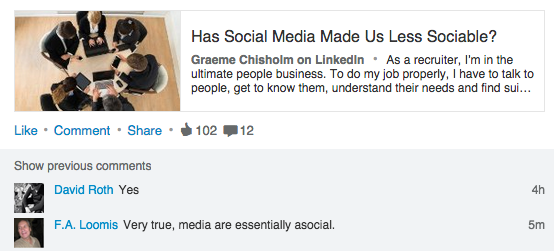
On Linkedin and Facebook people believe that mobile phones are making people less sociable then they would be if phones were not around. They believe that the world in which we lived before mobile phones was an open and sociable place where everyone communicated with everyone. These people are forgetting the social context that brought them Home Alone, Problem Child and other films. Society and social interactions have always been about finding the people whom you appreciate and those whom you prefer to keep away from. In the age before mobile phones I remember watching films and cartoons where certain characters were ostracised for being different. These people were seen as isolated or loners. Society does not like these people. We see it conversation and we see it in films. If a group of people in the physical world does not want to spend time with you, does not want to listen to you because your passions are incompatible with theirs, because your tone of voice is not right then that is their right. These people though, are not satisfied with excluding you from their conversations, are not satisfied with having their monologues and showing no interest in you. They will go a step further. They will prevent you from entertaining yourself. One of the most common forms of entertainment when people are not fully engaged with groups is the mobile phone. Mobile phone use is stigmatised by a lot of people. Just a few weeks ago I took a chance and met with a new group. As I am an ingress player and as I had nothing positive to add to the conversation I took the opportunity to farm from two portals that were in range. As I live in the countryside Ingress “farming” is a treat and I took advantage of the opportunity. I was listening to the conversations taking place on both sides of me. On one side it was the stereotypical “What do you do?” International community conversation and on the other they were discussing a few topics. One of these topics was music festivals. I have had a lot of fun at music festivals but I also have some views that I share with facebook friends rather than the wider world as it would see me ostracised. As I drove home from the meeting above I got a text message and felt that it would be bad. I read it when I got home and left the group. I won’t be told how to behave by strangers. I won’t be judged in a town by a group of people who hike and do via ferrata. If you participate in both of these sports there is a good chance that you will appreciate my company. When I am in the mountains one of the cameras I carry around is out but my mobile phone is in a pocket until I get to the end of the activity or the car. I am a member of the Geneva Ingress Resistance as well as the Lausanne Ingress resistance. As a result of this I have access via Google Hangouts to at least 120 people in the Lac Léman (lake Geneva) region. These people are unique. What makes them stand out is that they’re always looking at their mobile phones and when you see the entire group is silent it’s because they’re “glyphing”. I like to spend time with these groups because we eat crisps, drink wine, eat ice creams, hike and do other activities. These people meet because of the game but you see that there are deep friendships that have benefited from mobile phone use. I love the paradox. The paradox is as follows. Every user is in the Google Plus community, every user converses with other players in Google Hangouts and every player meets other players in the real world. The mobile phone is a link between those who are not present and those who are present. In effect whether you converse with these people from a computer, by mobile phone or in person changes little. Last week at the end of one operation to field over Yverdon with blue fields and another operation to field another city a phone call was made via google hangouts and we all answered and put the phones to our heads for a conference call. Instead of the mobile phone isolating people it is doing the opposite. It is uniting people. Look at the conventional social interaction. When two normal people call each other the people you’re with are isolated for a period of time. It’s the same when people in face to face conversations start talking about mutual friends, certain types of activities and more. Sometimes the conversation that two conventional people are having is more likely to isolate the people you’re in the same physical location with. More often than not small talk is frustrating because A) you don’t know whom they’re talking about and B) you don’t know the context. As a result small talk is less polite than mobile phone use. I love the mountains and I enjoy via ferrata and hiking when it’s with the right people. I also enjoy spending time with ingress players. With these three groups of people I feel that I can be myself. I spend no time acting and performing. They appreciate the real me.  When I go to towns and listen to normal people small talk I get bored and I feel isolated. It has nothing to do with the mobile phone and everything to do with the difference in interests and passions. If we don’t have the same interests and passions then don’t blame mobile phones for our lack of conversation. Either we find something we are both passionate about or we co-exist in the same space without talking much… Sometimes the inability for people to accept silence when they are not alone encourages others to be alone.

Social networks and project collaboration

Jacques Yves Cousteau’s documentaries would have done well in the social media age, especially if the social media age moved away from profit and money. Imagine that social media companies such as Facebook and twitter were Not For Profit Organisations and imagine that instead of having advertisers they had sponsors. The quality of content and discussion would increase and the time wasting element that so many people worry about would be gone. Alexandra Cousteau, grand daughter of Jacques Yves Cousteau is on twitter and she shares articles related to conservation and related topics. Not for profit organisations such as MSF and UN organisations such as the United Nations Development program all share content and articles that provide their followers with valuable resources for bringing conversations forward. Social networks should be seen as anything but a waste of time. Their purpose would be to find clients, to find collaborators and to find mentors. In having these three resources finding new projects, employment and collaboration opportunities would increase. We would eliminate viral videos, tabloid content and keep high value, high return on investment prospects. Rather than PR and marketing specialists flooding our timelines with emotional but useless content we would have high value content worth responding too. The aim would be to demonstrate our strengths in a high brow environment where conversations are possible and encouraged. From the time I was ten years old I have lived in the international community, between school, where I worked, university and more. As a result friends are distributed around the world rather than driving distance. Imagine that this network stopped seeing social networks as tabloid as commercial and a waste of time and instead saw them as useful work tools. For me this is nothing new. When I was in London when twitter was in it’s infancy and when facebook too was in it’s infancy I saw both social networks as networking tools. I met hundreds of people via both networks and I continue to do this today but at a less efficient pace than I would like. The aim would be that for every four or five days of social media use I would get two or three in person meetings with people to discuss projects and collaborations. I would also like to be inspired and encouraged to work on specific projects. The Game Ingress by Niantic labs is a perfect example of what I would like to see within a professional context. Through the game Ingress I have met people in Paris, Fribourg, Lausanne and Geneva to mention just a few. If I go to Paris on the 22nd I can meet agents. If I follow mission days or First Saturdays then I can meet people in a number of cities. I mention this because although ingress is not a professional network it is still a project network. It requires geographically based teams to collaborate to achieve goals. If we could distribute that kind of network for documentary production and collaboration then employability and familiarity would both benefit. It’s a shame that with all of the communication tools we have today we see social networks such as facebook and twitter as PR and marketing tools rather than collaboration and relationship tools. I have web designers, musicians, camera operators, writers, journalists, photographers, fundraisers, financial analysts and digital analysts as friends on Facebook and yet it is hard to see what people are working on. Imagine social networks that are optimised to benefit from your existing network.

Has Social Media made us less sociable?

[caption id=“attachment_2438” align=“aligncenter” width=“554”]As an extrovert of course you’d believe this. As a mid to late adopter you’d also believe this. As an extrovert of course you’d believe this. As a mid to late adopter you’d also believe this.[/caption] Introverts who are not going to compete with extroverts, through social media, have an opportunity to have friendships and interactions that would otherwise not occur. To say that Social media makes is unsociable is a fallacy. When I was a uni student the second time around I was socialising with fellow students all throughout the day and I was also active in social media. In 2007-2009 facebook was my university friend network. Twitter was strangers. Facebook was an extension of my physical social life. Twitter was an opportunity to meet new people. It helped me meet people from tuttle. It introduced me to Seesmic when it was in Alpha. I conversed with some of the big names of the time and went to podcamps. I was invited to Leweb in Paris in 2009 and we met had seesmic meetups a number of times More recently playing Ingress by Niantic Labs has helped me meet people in Paris, lausanne, Fribourg, Geneva, Nyon and other places. To say that social media makes people less social is to ignore that people use social media for conversations, not for brands. The fallacy of most “social media professionals”, “Social media experts” and other “social media” snake oil practitioners is that they go home to a spouse or better half. They have no need to create a relationship with the people they are interacting with. As they do not create relationships with those who use social media they are kicking dust in the Atacama desert in the hope to raise enough dust to create a nucleus to which water will collect and fall as rain water. There is a shift in social media today. It is a shift away from conversations especially on websites such as twitter and facebook towards brand brainwashing. As a result of this facebook and twitter have lost engagement. That is not to say that other niche social networks are not benefiting from the ground broken by Facebook and twitter. In particular I am thinking of websites for slow ups and other group activities. I’m thinking of OVS (on vas sortir), Glocals (Geneva Locals) and many other social networks. I notice that the expatriated and international community benefit strongly from websites that encourage groups of people to do communal activities. Thanks to Glocals I scuba dived every single weekend for more than a year, I learned about Via Ferrata and loved the sport, I finally got to rock climb, I enjoyed canyoning and more. The idea that luddites can constantly bash social interactions via computers and electronic devices fatigues me. You know what the most amusing thing is about the people who say that social media reduces conversations is? Their one word answer. :-D. Don’t you just love the irony?

The Lowest Common Denominator

When animated gifs were new and overused on geocities they were tiring. They were used by people whose homes are surely filled with kitsch. Facebook, with it’s declining user engagement decided that it would join the “me too” bandwagon. As a result of this we will see a noisier unsociable feed. Twitter has made retweets confusing today. When something is retweeted or commented on you want to see the relevant tweet with the comment. As retweets are today we see a comment and a hyperlink. That comment and hyperlink are useless as they require you to click through to understand. In some circles this would be seen as spam. Users must always know where the link they are clicking is taking them. I look forward to finding conversation sites where user interactions are the reason for the network to be in existence. At the moment too many “social networks” have encouraged spammy behaviour rather than conversation. As the social networks are filled with junk so the statement that “social media websites are a waste of time” is being made clearer every day.

Video piracy in the 21st century

A few days ago I was watching a Magnum PI episode where Higgins had a film camera pointed at the television screen to record a game of snooker broadcast from “half way around the world” by satellite.  Today I noticed this article speaking of the way in which twitter’s Periscope app and Meerkat were used to pirate a fight. Piracy is nothing new but the simplicity with which people can pirate and share content has evolved. Piracy required rolls of films at first. These rolls had to be developed and then copies had to be made. This could take several days. VHS came along and made it easier. With several VHS decks you could make several copies at once. Steve Jobs is well known for the boot leg tapes he had of music concerts. My generation streamed live music concerts using mobile phones. Football enthusiasts used satellite receivers and streaming software to re-distribute live football matches years ago. This is true both for european Football and American football. The live streaming of broadcast content is now so simple that multiple people, using social media, redistribute content as it happens. There is no lag time. There is no exclusivity possible. PeriscopeTV and Meerkat have made it very simple to share live events circumventing the gate keepers. Gate keepers provide the highest audio and video quality possible for their customers and for this reason they are safe for now. The pirated copy has low video and audio quality and is filmed by a mobile phone camera. Social networks such as Twitter and sporting organisations will need to strengthen their collaboration. Both of them can and will benefit from joining forces. If PeriscopeTV and Meerkat both get paid by the Fight promoters to carry the signal as premium content then the pirate streams will be of less interest. Price will have to reflect the platform on which content is being shared of course.