360 Video

Day Twenty-Six of ORCA in Switzerland – Playing With 360 Video

It’s Day 26 and today I was playing with 360 video. Specifically I went for a walk in the woods and placed the camera ahead of me to provide people with the opportunity to look around. Doing this is a risky strategy during the pandemic because if you cross paths with anyone there is nowhere to avoid them. I quickly went back to open space and retreated for home. One runner passed too close.
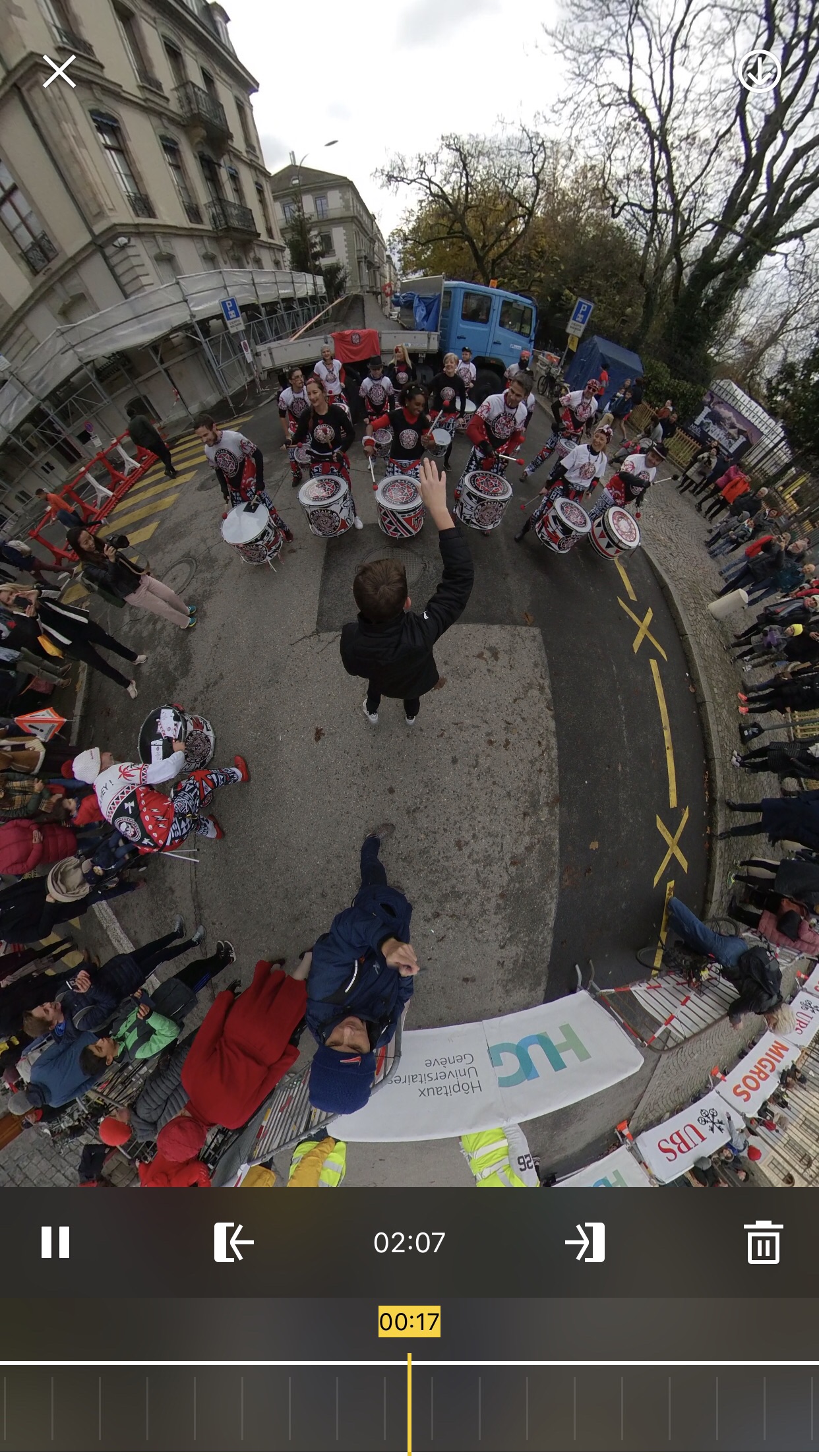
Filming events in 360

We have all seen events covered by photographers and camera operators but how many events have we seen covered with 360 degree videos?

A few weeks ago I filmed the Escalade, wrestling and other events with 360 cameras and it was fun. In some cases it was the opportunity to play with a new format and in other cases it was the opportunity for proof of concept.

The thing to remember about 360 videos is that you’re placing the camera at a point in space and people can look around as if they were holding the camera. Of course rather than hold the camera with their hands they are holding it with their fingers or even on their heads.

Climbing Virtual Reality, Uniform and Grip

Climbing Virtual Reality tuition is an interesting idea. Learning to climb is fun because it is a physical and intellectual challenge. The first step is to familiarise yourself with the sensations of climbing and learning to see where foot holds are and where hand holds are. When you begin the hand holds are easy to find and hold on to but as you progress and attempt more challenging routes you need to develop finger strength to hold on to those holds. Climbing Virtual Reality tuition is an interesting idea. In some cases though finger strength is not the only challenge. You also need to learn to read the route and to know which hand to hold a hand hold with, which foot to use on a foot hold and how to reach the next hold. You can learn through trial and error which is fun or you can climb other routes and wait until someone who knows the route that has you flummoxed decides to climb that route. Virtual reality Goggles are an alternative way of learning how to climb a route. In the example provided in the video above Grip by Uniform provides climbers with an alternative. In their example they speak about Shauna coxsey participating in the project and allowing people to film her as she is coached on how to climb a route. In other locations it could just as easily be the route setters. It’s interesting to see such a project because the question we often hear people ask is “How did you climb that route” and the answer is often “I don’t remember”. With this technology it would be easy to provide people with guidance for the routes they find more challenging. It is a new and immersive form of tuition which could help people progress and learn climbing skills more efficiently and within a shorter amount of time.

Watching clouds form as a 360 timelapse

Time-lapse videos are fun because we can see something happen faster or slower than real time. By watching this content we gain a better understanding of the world and how it works. For years I have been filming time-lapses and the results can be fun. In some cases we record time-lapses with video cameras and at other times we set an interval timer to take pictures every so many seconds. In this post you will be watching clouds form as a 360 timelapse. I have chosen to share both the flat image and the spherical image. The reason for sharing both versions is to give you an overview of how objects move in both.

Rain and the Gear 360

zproxy - Sep 4, 2016

actually. the device tends to overheat and drain battery rather fast for long recordings.

Rain and the Gear 360

Rain and the Gear 360 are well suited to the weather we are currently subjected to in Switzerland. For the past month and a half we have had rain almost every single day. As a result of this it has limited the number of opportunities to go out and get 360 footage. 360 camera rigs are not designed for rain. Most 360 rigs involve at least six non weatherproof cameras and rigs that are designed for dry rather than wet conditions. To go out in this rain would drown the equipment. With additional funds you could film in these conditions with weatherproof gear but the cost increases. Add to this that camera systems like the Ricoh Theta S prefer clear skies and nice weather for taking video and you see that it is not really worth the effort. By the end of September the Samsung Gear 360 should provide us with a simple to carry, weatherproof 360 camera which could be fun to take canyoning (if they make a specialist housing) or hiking for doing other sports activities where weather proofing is a useful feature. The trend to make devices at least splash proof is good. Another nice feature of this camera is the ability to use 200 gigabyte SDHC cards. with these cards you can record for hours. When the card is full or when you’re changing location you can change cards in seconds and continue working on a project. With the Ricoh Theta S you can record for 45 minutes before you need to transfer the footage, clear the memory and start recording again. With 200 gigabytes of storage one concept that I would love to test is 360° time lapse videos. You could fix the camera to your bike, to a canoe or to some other object and set it to take a picture at regular intervals. So far I have not seen a mention of an interval recording mode but with 200 gigabytes you can record for hours without worrying about storage. You could change the speed in post production. This camera records in UHD rather than HD quality. Video recording is at a resolution of 3840x1920. 360 videos taken with this camera should be more pleasant to view as a result. The 360° video eco-system is still in it’s infancy and most 360 video solutions require people to use a number of cameras. Both Samsung and Ricoh provide all in one solutions along with software to stitch the images ready for post production. They are helping to democratise the medium both by making production cheaper but also by enabling people to produce content. This increase in content will encourage more people to get VR goggles which in turn will justify increasing the budget of 360 video production budgets. It will go from being a niche product to being mainstream.

The Immersive Video Experience

  I was at the World Virtual Reality Forum in Crans Montana this weekend as a volunteer. During this time I was able to try many of the demonstrations and get a real feel for the potential of 360° and immersive videos. I was also able to listen to people comment on what they appreciated about the experiences and what they did not like.

Vulkane in 3D und 360

One of my favourite experiences was Vulkane in 3D und 360. I worked at this exhibit two out of the three days helping two people at a time every three minutes experience this. I had watched a number of videos before this one and when I watched this one I said Wow because the experience was so beautiful. The quality is excellent and there are some vistas that are spectacular. We are familiar with watching volcanic eruptions but with this experience we are watching the scene as if we are there. As the volcano erupts we can see the projectiles and follow their course through the sky. This is a novel experience for many of us.