Tech Related

Video piracy in the 21st century

A few days ago I was watching a Magnum PI episode where Higgins had a film camera pointed at the television screen to record a game of snooker broadcast from “half way around the world” by satellite.  Today I noticed this article speaking of the way in which twitter’s Periscope app and Meerkat were used to pirate a fight. Piracy is nothing new but the simplicity with which people can pirate and share content has evolved. Piracy required rolls of films at first. These rolls had to be developed and then copies had to be made. This could take several days. VHS came along and made it easier. With several VHS decks you could make several copies at once. Steve Jobs is well known for the boot leg tapes he had of music concerts. My generation streamed live music concerts using mobile phones. Football enthusiasts used satellite receivers and streaming software to re-distribute live football matches years ago. This is true both for european Football and American football. The live streaming of broadcast content is now so simple that multiple people, using social media, redistribute content as it happens. There is no lag time. There is no exclusivity possible. PeriscopeTV and Meerkat have made it very simple to share live events circumventing the gate keepers. Gate keepers provide the highest audio and video quality possible for their customers and for this reason they are safe for now. The pirated copy has low video and audio quality and is filmed by a mobile phone camera. Social networks such as Twitter and sporting organisations will need to strengthen their collaboration. Both of them can and will benefit from joining forces. If PeriscopeTV and Meerkat both get paid by the Fight promoters to carry the signal as premium content then the pirate streams will be of less interest. Price will have to reflect the platform on which content is being shared of course.

Ingress Operation Apache, Covering Geneva in Blue.

Operation Apache

Operation Apache Ingress is a selfless game when you play as a team. The driver gets no AP. Other operators get a few AP for breaking portals. Three individuals gets hundreds of thousands of Mind Units (MU). Rather than feel a sense of achievement I feel fatigue. The first reason is to do with the hangouts. You have to be serious. When I work in a team I want to be able to joke around. The most fun you have is with people who know what they’re doing and despite the stress have fun doing it. When you do something for free this is even more important. The second is driving a hundred kilometres. I don’t like driving without something to do at the destination. I also prefer to be active during daylight hours rather than once the sun sets. I am not a vampire. The three day rains don’t help either. Three days of rain, seeing the Arve saturated and very high. The Pont Rolex is a metre from being flooded. Friday I drove three hundred and seventy kilometres for another operation. I drove an hour to the location and an hour back from the location. On this previous up the engine had run for six and a half hours. I drove up one slope and fire crews were present. They allowed me to go on and I drove up beside the stream running down. The water wasn’t too deep but there were a lot of stones and mud. I felt the car loose traction so tried to keep my speed up. I saw where a storm drain intended to take water in was overflowing like a spring. In total I drove 470km on half a tank of diesel so fuel wise it was probably still cheaper than driving to meet people in Geneva. I think I’ll take a break from communal activities and play solo. I’ll stick to Via Ferrata and hiking as team activities. I will feel good about the op in a few days, when the sun starts to shine again.
Social conversations and the social media

If you read “How to Win Friends and Influence People” you see how important it is to take notice of other people, to be positive and to be interested in what they are doing. That can be a challenge for everyone. We all have different priorities so putting other people first is a challenge. The World Wide Web is a place where we can listen and talk at the same time. We listen to a conversation and then we comment. We can start our own conversation and wait for others to see it and respond. As a result we are both engaging with others and letting others engage with us. There is a bilateral trade which leaves both parties feeling good. Social media, today a misnomer, was a conversation place. Everyone talked with everyone and everyone became familiar with everyone else. The Global Village that Marshall McLuhan wrote about looked like it would become a reality. At the time when this reality looked the most feasible was the time before mobile phones and proper data plans. At this time we used computers from a fixed location, either at home, an office, university or other places. With Wifi we had some freedom but nowhere the freedom that smart phones and data plans have provided us with. That’s why people’s feeling that mobile phones are disconnecting people is such a ridiculous notion. In my vision of the world, in the adoption cycle that I observe the mobile phone is the great connector. We meet people online, we appreciate them, we meet them in person. Seesmic and the early days of twitter were very good tools for this lifestyle. As data plans included more and more data so it would follow that social media websites would be about individual to individual conversation. It would logically follow that people would feel more at ease conversing online as their friends adopt the technology and have chats. Facebook, twitter and Google Plus should be social web forums where people are interested in the people they follow. What I see, as data plans and smartphone adoption rises is the opposite. People share links and promote rather than converse. Social media should be rebranded as Ego Media, brand media or advertising media. The platforms that should have made us conversational have been overtaken by advertising. It’s a good time to continue blogging. It’s a monologue until you contribute a comment. The World Wide Web is a de-centralised conversation tool and we move from platform to platform looking for the places where the personal connections are strongest. As the social media days fade in to history now is the time for each of us to blog, to write about what we feel passionate about.

The Crosscall Odyssey Plus

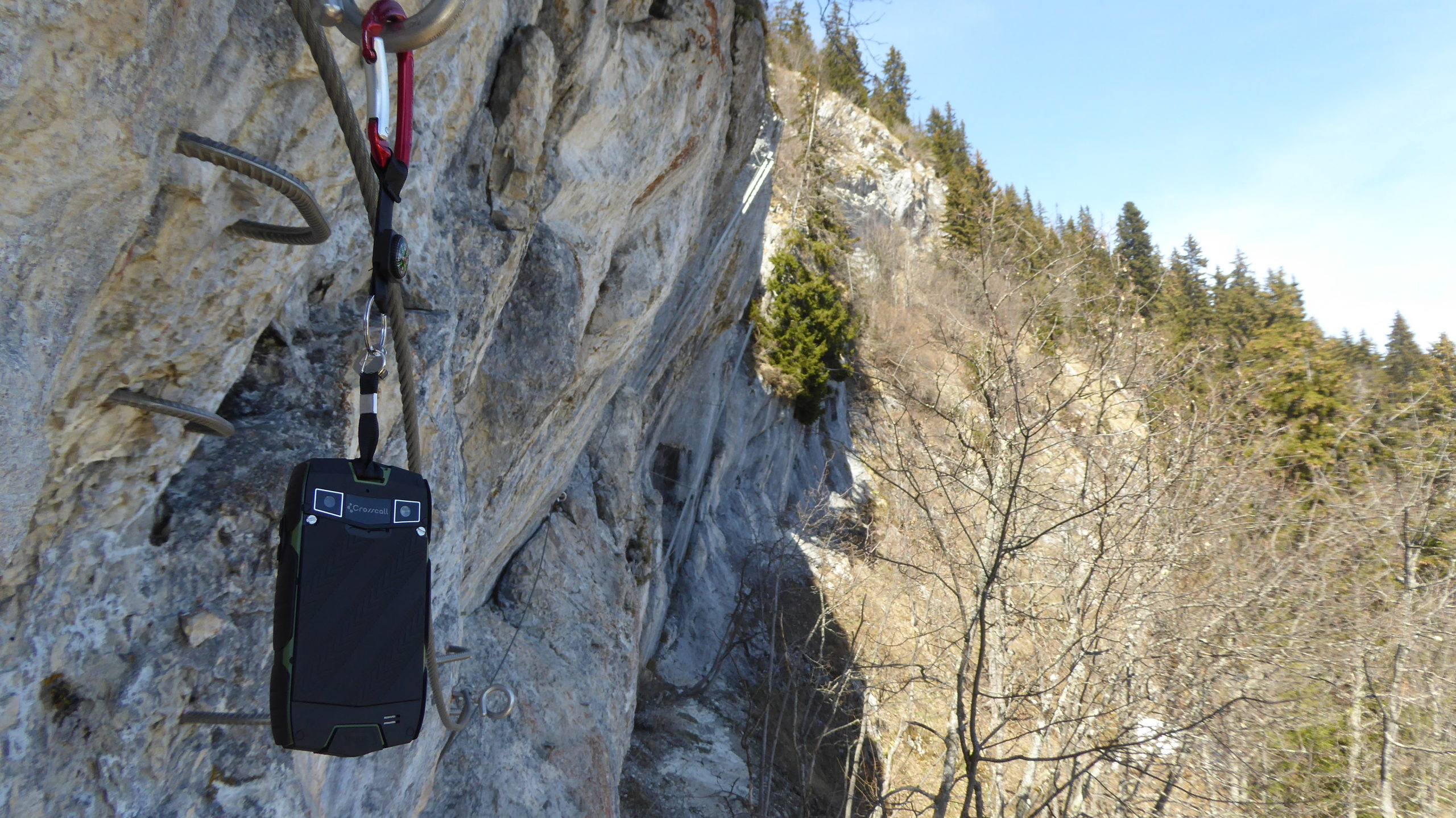
  The Crosscall Odyssey Plus fills two niches. It is a rugged weather proof phone rated to the IP 68 standard and is equipped with dual sim capability. This makes it ideal for the sports I enjoy, mainly via ferrata as pictured below and hiking. It comes with a smaller carabiner than the one pictured below. I swapped it for one of my own. 1030283 IP 68 is a code to determine how resistant a device is to both particulate matter and liquids. 6 denotes that the device is dust tight so particulate matter will not make it’s way in. 8 as defined by the manufacturer denotes that this device can be submerged for half an hour at 1m before damage occurs. If you get caught in the rain or have to cross a river the phone should survive. Another interesting feature is the dual sim capability. This phone allows for two microsims to be used at once. In my case I have a Swiss sim card and a french one. Both sims are constantly active so you can select whether to make phone calls from Sim 1 or Sim 2. You can also select which sim card is using the data plan. It runs android 4.3 and works fine with the TomTom app, the ingress and others. I found that battery life is also comfortable. With me as a user the battery lasts for a day. more info

Pride and media consumption

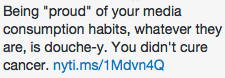
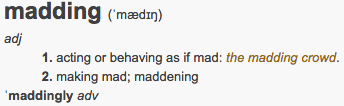
I enjoyed reading the Unbearable Lightness of Being so much that I read every book by Milan Kundera. I also read every book by Albert Camus because I enjoyed reading La Peste so much. Laura M. Holson wrote an article about “Unplugging without FOMO” which I skimmed after someone on twitter commented on twitter that Screen Shot 2015-03-29 at 18.45.06 and I strongly disagree with this person’s view. It brings us to the conversation about high and low culture. I take the view that media consumption should be focused on high culture. For my dissertation I watched hundreds of documentaries. I watched every David Attenborough documentary, every Jacques Yves Cousteau documentary. I read many books and articles on the topic of the documentary genre and as a result I take pride in the knowledge that I have acquired in the process. When I skimmed through the article I saw that the discussions were about low culture, about tabloid topics. They speak about things that I would never discuss as they are of no importance or interest. These are things that have no effect on my quality of life. At the same time I do feel the usual regret. Mid to late adopters came to social media, made it tabloid and then complain about the stream which they and their friends generated. In my childhood I read encyclopedia articles during breakfast, as a teen I spent hours in computer rooms learning about webmastering and search engine optimisation before others were interested. I was experimenting with video compression tools in the late 1990s and gained a deep understanding of the tools that would lead from new media to social media. The conversations were about culture and people took a constructive attitude. From 2009 onwards I saw the shift away from personal conversations between friends to the hunt for followers and the loss of the personal connection and I blogged about it. As I went back to read the article about unplugging so I see a reaction to what I have been saying for years now. Articles are being written for people with no staying power. Social networks are becoming broadcast rather than exchange and the superficiality of the web is driving people away. I am happy that social media and microblogging are beyond their sell by date because it means that I can give time up to blogging once again. I can once again discuss topics that interest me in long form. It means that we will spend more time reading, more time learning once again. That is the beauty of the shift away from social media. In reality I have nothing to gain from participating in the Meme media. Même media, the Same media. The media where people use hashtags to be certain that they are in the flock, the flock of hashtag users rather than conversationalists. If I can’t converse I will have a monologue and people who are like minded will find me and we shall converse away from the madding crowd. Someday I will read that book. I love to read and I love to write. Today I am doing both as it’s raining outside. Screen Shot 2015-03-29 at 19.14.02

Headline rating app to encourage useful headline writing.

In future I would like an application or social network that allows me to rate headlines according to whether they are sensationalist, informative, emotional informative or other. The aim of this network or app would be to discourage article writers from re-using the same phrases over and over. It would encourage writers rather than marketers to provide headlines that article readers want to follow. I often see articles that I would find interesting but because of the way the headline is written I avoid it. I don’t want to give marketers a victory for condescending to their audience. I also worry about the article’s informative value. Will the article provide me with some new information or is it so general that I already know this. Articles need to provide me with a return on investment. I want to be informed, educated and entertained.

Social media, loneliness and isolation.

“The pathology of social media is all about loneliness” Social media professionals take the weekend off. Twitter users use hashtags so that their content can be found without being followed. Everything is turned towards discoverability rather than commitment and conversation. Social media practitioners know that people aren’t listening attentively so they repeat and repeat in the hope of a click or two. Hashtags are just a way of pretending that a conversation has had an audience. It doesn’t measure the number of comments and responses. It doesn’t measure how long threads lasted before they stopped. There was a time when people like me would read every tweet from people we followed and we would converse daily. It created a lot of friendships and led to a lot of face to face meetings. In today’s social media landscape I do see loneliness rather than socialising. I see on twitter that people are actively posting only once or twice a day. On Facebook I have seen such a serious decline in participation that there is little reason to stick around. My generation were active in social media for a short amount of time and now they have retreated to “normal” life. Whilst some people have hundreds of likes on their instagram images I have half a dozen to a dozen. Almost every like on Instagram is a person that I have conversed with online for years. There is a chance that I can tell you how long we’ve been chatting online, whether we’ve met in person and at what event and which networks we have shared. Twitter friends were trusted enough to become facebook friends. Facebook and twitter friends followed on instagram etc. Facebook was a very active and social place when we were all at university and having the same social life. Twitter was a very social network when I was looking for work and meeting the London Social Media crowd, the French social media crowd and the Swiss social media individuals. Ingress has presented me with a large group of Swiss people whom I have met many times recently as an active player of Ingress. Many of them are around my age.  We use Google hangouts to talk and plan missions and are in constant communication. Glocals was good for finding people to explore new activities and locations with but the connection lasted only as long as the activities. There was little to no follow up socialising online. The Glocals Scuba diving group is the one I got along with best and the group with which I did the most activities. It’s a shame that this was an activity for people a decade older than me. When I think of the social journey both online and offline I see that loneliness is not the pathology of social media. I joined Twitter because I love to try new things. Facebook was a network of university friends whom I saw every day. Seesmic was a network of people whom I developed strong friendships with that last to this day and Glocals was probably the only network I joined out of solitude and a need to do things on weekends. I like the irony that the network I joined to avoid solitude is the one that resulted in the deepest feeling of it. Eventually every social network becomes lonely but we would say the same about the city from which our friends have gone, of the bars and more. Geneva is referred to as an airport hub. People come to the city for a year or two and then leave. As a result the refreshing of friendships is very high and it takes a certain personality to cope. Modern transportation; planes, cars, and trains create a pathology of loneliness and social media are part of the solution for as long as the social networks are frequented.

Audible books and Kindle Unlimited

This year I have set myself the goal of reading 30 books. I am currently on track to reaching that goal. Most of my reading material comes from two sources. Audible.com and amazon.de. What I like about reading books via Audible.com is the freedom it gives me to do something at the same time as people are telling me stories. This habit was born from listening to podcasts while I went for hour long walks. Over time podcasts went down in quality and my time was taken up by other activities. As a result of the scarcity of time I moved towards audible books. Audible books provide me with an opportunity to listen to stories and learn whilst I do other things. I can listen to them while I commute, while I go for hikes or while I mow the lawn. As a result of this ability to multitask I have finished many more books than I would finish if I was only reading. I am an audible platinum member and I pay in advance. This gives me the option to buy 23 books a year. Audio books are not cheap when you buy them individually so buying a subscription makes sense. Below a certain price I buy the books and use credit when the value justifies it. For at least two years I have felt justified in keeping the subscription. I am lucky because I like to read on electronic devices. I have used iphones, android phones, iPads, iPad Mini, Tablets and a kindle for reading. As a result of this I always have several books with me at all times. I have a tendency to buy many more books than I have the time to read. This is especially true of books when they cost less than an airport coke. Eventually I will get to read them. Today I took a step which may make conventional book readers envious. I will test Kindle Unlimited for the next month. I can “borrow" up to ten books simultaneously per month. I can be as uncommitted as ever with books. I am working through the James Bond Collection and reading three history volumes at the same time.  I “read” the history volumes as audio books and this allows me to enjoy the nice weather we have had. When I am in a fixed location I can read James Bon books on the kindle. At the end of the trial month we will see whether I keep using Kindle unlimited.

Access to contemporary technology helped promote my habits as an early adopter.

Parents in the silly con valley are idiots. They are in a trillion dollar industry and make billions a year because people want to use the technology they are developing. Think about how different my childhood would have been if we had learned camera work and video editing in art classes rather than painting, pottery and other less interesting art forms. Imagine if as a child I had not watched Cousteau Documentaries. Two of my strongest passions would never have emerged… scuba diving and documentary making. The luddites who amass personal wealth worth billions should understand that new technologies promote creativity and innovation rather than the opposite. Look at games and how they have evolved. Look at the emergence of multiplayer gaming right up to the leading edge games like Ingress among others. Without creativity and free time with new technologies revenue would be less forthcoming. My passions for video and editing were held up for many years because I had no access to an edit suite. Imagine how the children of Sillicon Valley execs are having their creativity stunted because of the very people who have most to gain from their children being early rather than late adopters. “Those who endorse this approach say computers inhibit creative thinking, movement, human interaction and attention spans.” These people demonstrate just how limited their understanding of modern technology is. News organisations are teaching their staff how to shoot and edit news stories using mobile phones, others are using tablets to write books and more. The idea that information technology prevents people from moving around in today’s world is redundant. How many of you still have a desktop at home that you use regularly. I personally use my mobile phone and a laptop most of the time. The laptop is with me everywhere I go. As a child and as a professional the thing that limited my movement is classroom and office time. In the classroom you learn at the speed the teacher chooses. There is no fast forwarding, skimming or rewinding. Everyone learns the same information at the same speed… in theory. In practice we learn at different speeds and information technology allows us to build knowledge actively. As children we had books and we learned by reading different chapters at different moments. Imagine studying the Roman civilisation as a child and wanting to see pictures and video from the time. Multimedia devices and computers would bring more to life quicker. I strongly believe that children should be given the freedom to use the technology or medium they want to use. It is not up to adults to decide which tools are relevant to their children. As an early adopter contemporary values and norms have held me back and stop others from keeping up.